Is Wall Street Entering a New De-Risking Cycle in 2026?
In February 2026, concerns began emerging across global financial markets around the private credit sector and its exposure to rapid technological disruption—particularly from artificial intelligence.
While headlines have framed the situation as a potential systemic shock, the reality appears more nuanced. This article breaks down the situation by separating verified structural risks from market interpretation and narrative-driven speculation.
Market Volatility Among Alternative Asset Managers
Recent trading sessions saw heightened volatility among major alternative asset managers involved in private credit markets.
Companies frequently referenced include:
Blackstone
Apollo Global Management
Ares Management
KKR
Blue Owl Capital
These firms are naturally sensitive to:
Interest rate movements
Credit spread expansion
Liquidity conditions
Daily price swings in the 3–6% range are not unusual for financial stocks. However, the synchronized movement has drawn attention to broader concerns surrounding private credit exposures.
At this stage, market behavior suggests risk repricing, not confirmed systemic stress.
The Rapid Expansion of the Private Credit Market
Private credit has grown dramatically since the 2008 financial crisis, reaching an estimated $1.6–1.8 trillion in global assets.
The expansion was driven by:
Post-crisis banking regulation (Basel III)
Reduced bank lending to mid-sized companies
Institutional demand for yield
Private credit funds now perform many traditional banking functions—extending loans directly to companies—while operating under a different regulatory structure.
This has led to the common description:
“Banks without banks
Structural Risks: Liquidity and Transparency
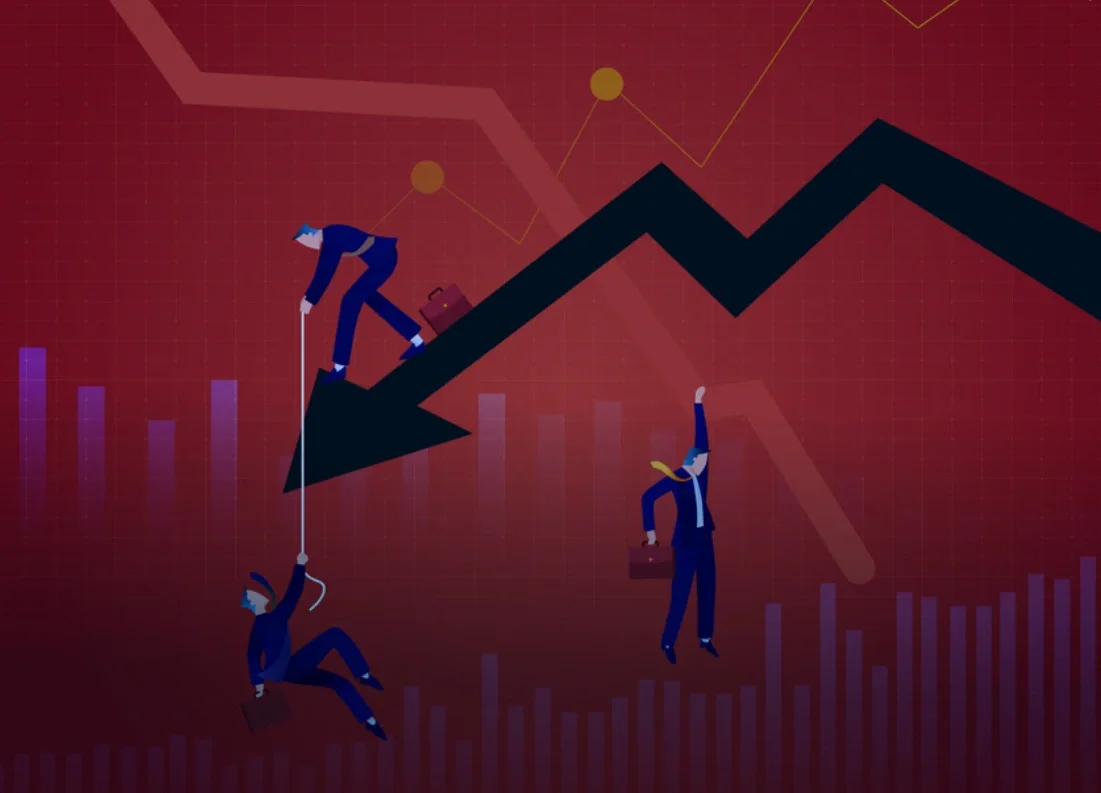
Private credit markets contain several well-known structural risks.
1. Liquidity Mismatch
Investors may request redemptions while underlying assets—private loans—remain illiquid.
2. Information Asymmetry
Disclosure standards are significantly lower than in public bond markets.
3. Valuation Lag
Assets are typically priced using mark-to-model methods rather than real-time market pricing.
This becomes particularly relevant during periods of market stress, when valuations may adjust slowly.
Blue Owl and the Redemption Debate
Recent discussions have centered around liquidity management measures within private credit funds, particularly those operated by Blue Owl Capital
Redemption limits—commonly called “gates”—are standard tools used across private markets to manage investor flows. These mechanisms are not unusual and do not automatically indicate systemic distress.
However, they often attract attention because they highlight the structural difference between:
At present, available information suggests a liquidity management issue, not a confirmed sector-wide crisis.
The AI Factor: Disruption Inside Credit Portfolios

One of the most interesting emerging narratives is the potential impact of AI on corporate credit quality.
The concern is straightforward:
Many private credit portfolios contain software and SaaS companies
AI is accelerating product cycles and competition
Legacy software margins may compress faster than expected
Some credit strategists have suggested that technological disruption could increase default risks in certain segments.
However, it is important to emphasize:
There is currently no confirmed data showing AI-driven defaults at systemic scale.
This remains an early-stage hypothesis, not an established trend.
Conclusion: Structural Shift or Market Narrative?
Private credit markets are clearly entering a more complex phase.
Structural vulnerabilities—particularly liquidity mismatch and valuation opacity—have existed for years. What has changed is the combination of:
At this stage:
There is no confirmed systemic crisis
There is increasing risk repricing
AI remains a potential accelerator, not a proven trigger
The key indicators to monitor going forward include:
The intersection between technological disruption and credit markets may become one of the defining financial themes of the late-2020s.
 Trade
Trade