A gradual money management strategy that increases investment by one step after a loss and decreases it by one step after a win.
Index
1. What Is the D’Alembert Strategy?
2. The Loss +1 Step, Win -1 Step Structure
3. Why It Feels More Moderate Than Martingale
4. Example Based on a 95% Payout Rate
5. Stage Pressure During Consecutive Losses
6. When Does This Strategy Feel Useful?
7. Comparison with Martingale and Fixed-Amount Trading
8. Practical Operating Rules
9. Real Trading Scenario: A Slow Recovery Structure
10. Situations Where the D’Alembert Strategy May Be Suitable
11. Recommended Operation Summary
12. How to Verify the Strategy: Average Stage and Maximum Stage
13. Key Points to Emphasize in Content
14. D’Alembert Strategy Exit Criteria
15. D’Alembert Strategy Demo Testing Routine
16. Conditions to Check Before Applying the D’Alembert Strategy
17. Final Recommended Position
18. Frequently Asked Questions
19. Risk Disclosure
Complete Guide to the Binary Options D’Alembert Strategy: A More Gradual Money Management Method Than Martingale
The D’Alembert strategy is a money management method that increases the next investment amount by one step after a loss and decreases it by one step after a win.
Like Martingale, it increases investment after losing trades. However, the key difference is that it does not double the investment amount aggressively. Instead, it adjusts the amount gradually, step by step.
Because of this structure, D’Alembert is often mentioned by traders who want to reduce the fast increase pressure of Martingale while still maintaining a structured recovery approach. The current stage is easy to track, and unlike Martingale, the strategy does not reset immediately to the base amount after a win. Instead, it decreases one step at a time.
In this guide, we will cover the basic rules of the D’Alembert strategy, a practical example based on a 95% payout rate, how stages grow during consecutive losses, how it compares with Martingale and fixed-amount trading, and what operating standards should be checked before applying it.
The investment amount increases by one step after a loss.
The investment amount decreases by one step after a win.
It feels more gradual than Martingale, but stages can still rise during long losing streaks.
Unlike Martingale, a win does not immediately reset the cycle to the base amount.
A maximum stage and stop rule must be defined before using the strategy.
1. What Is the D’Alembert Strategy?
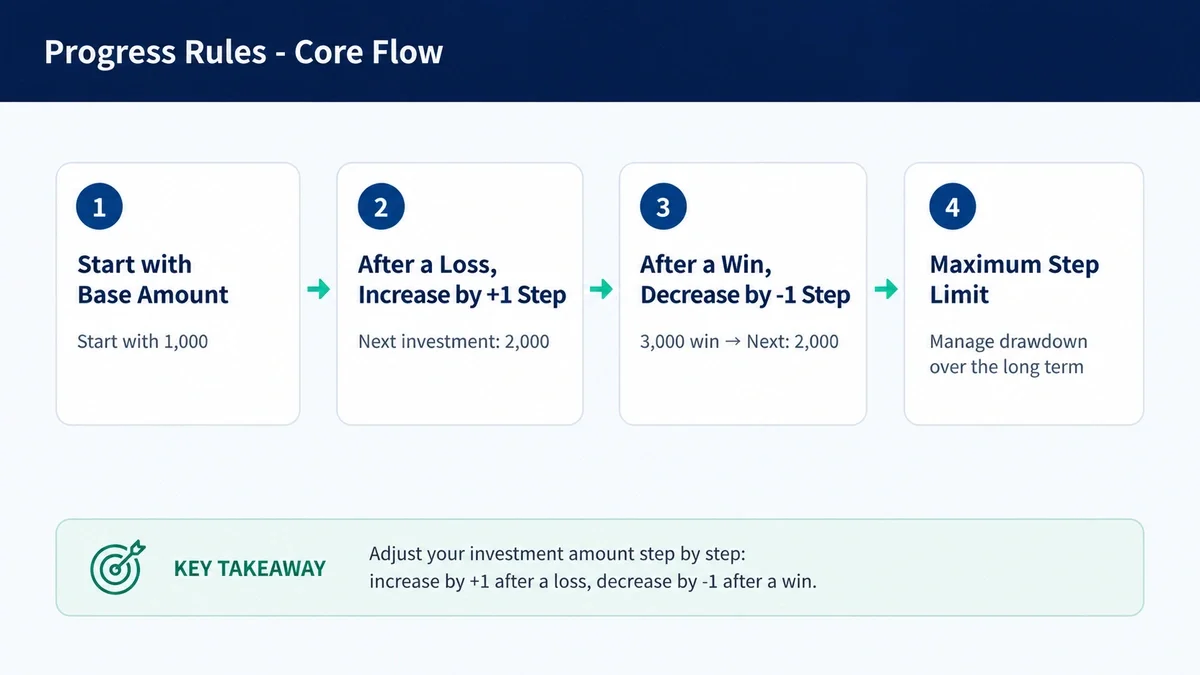
The D’Alembert strategy is a money management method that begins with a base amount and adjusts the next investment amount depending on the result of the previous trade.
If the trade loses, the next investment amount increases by one step.
If the trade wins, the next investment amount decreases by one step.
For example, if the base amount is 1,000, the stage structure may look like this:
1st stage: 1,000
2nd stage: 2,000
3rd stage: 3,000
4th stage: 4,000
If the first trade loses, the next trade moves to 2,000. If that trade also loses, the next trade becomes 3,000. If the following trade wins, the next stage decreases back to 2,000. If another win occurs, the strategy returns to 1,000.
This creates a stair-step movement where the investment amount rises and falls gradually according to the results.
At first glance, D’Alembert may seem similar to Martingale because both strategies increase the amount after a loss. However, D’Alembert increases much more slowly. This makes it easier to explain as a more moderate alternative to Martingale.
Still, “more gradual” does not mean “risk-free.” If losses continue, the stage can keep increasing, which means clear limits are still essential.
2. The Loss +1 Step, Win -1 Step Structure
The most important rule of the D’Alembert strategy is simple:
Loss: increase by one step
Win: decrease by one step
This is the core identity of the strategy.
Unlike Martingale, a winning trade does not immediately reset the cycle to the base amount. If the trader wins at stage 4, the next trade moves down to stage 3. If the trader wins again at stage 3, the next trade moves down to stage 2.
This makes the strategy feel more like gradual flow control than immediate recovery.
The structure can be useful because it prevents investment amounts from rising too sharply after losses. At the same time, it also means that returning to the base amount may take time after several losing trades.
In other words, D’Alembert does not focus on fast recovery. It focuses on slow stage adjustment.
3. Why It Feels More Moderate Than Martingale
Martingale increases investment amounts very quickly.
For example, with a base amount of 1,000, a traditional Martingale sequence may look like this:
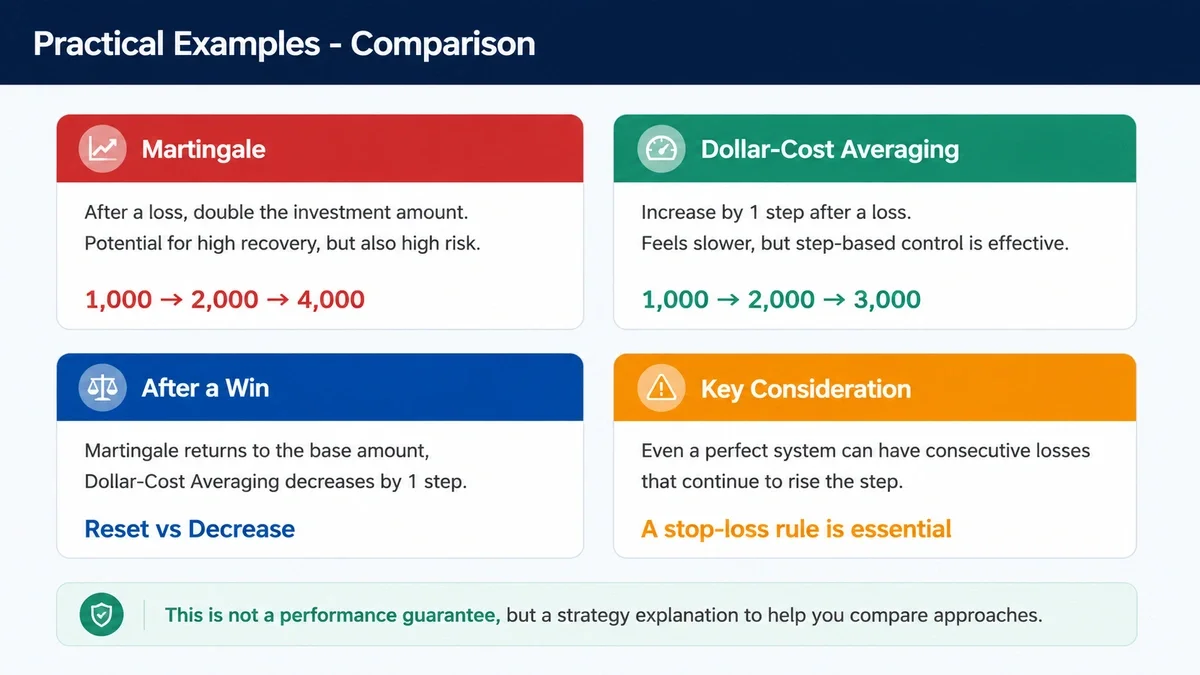
1,000 → 2,000 → 4,000 → 8,000
By contrast, the D’Alembert sequence increases more gradually:
1,000 → 2,000 → 3,000 → 4,000
This difference is important from both a capital and psychological perspective. In Martingale, just a few consecutive losses can cause the next investment amount to grow sharply. In D’Alembert, the increase is slower, so the pressure may feel more manageable.
However, this slower increase also means slower recovery. Martingale attempts to recover previous losses with one winning trade. D’Alembert usually requires a series of wins to gradually reduce the stage and recover the flow.
For this reason, D’Alembert should not be described as a fast recovery strategy. It is better explained as a gradual money management method that adjusts investment size step by step.
4. Example Based on a 95% Payout Rate
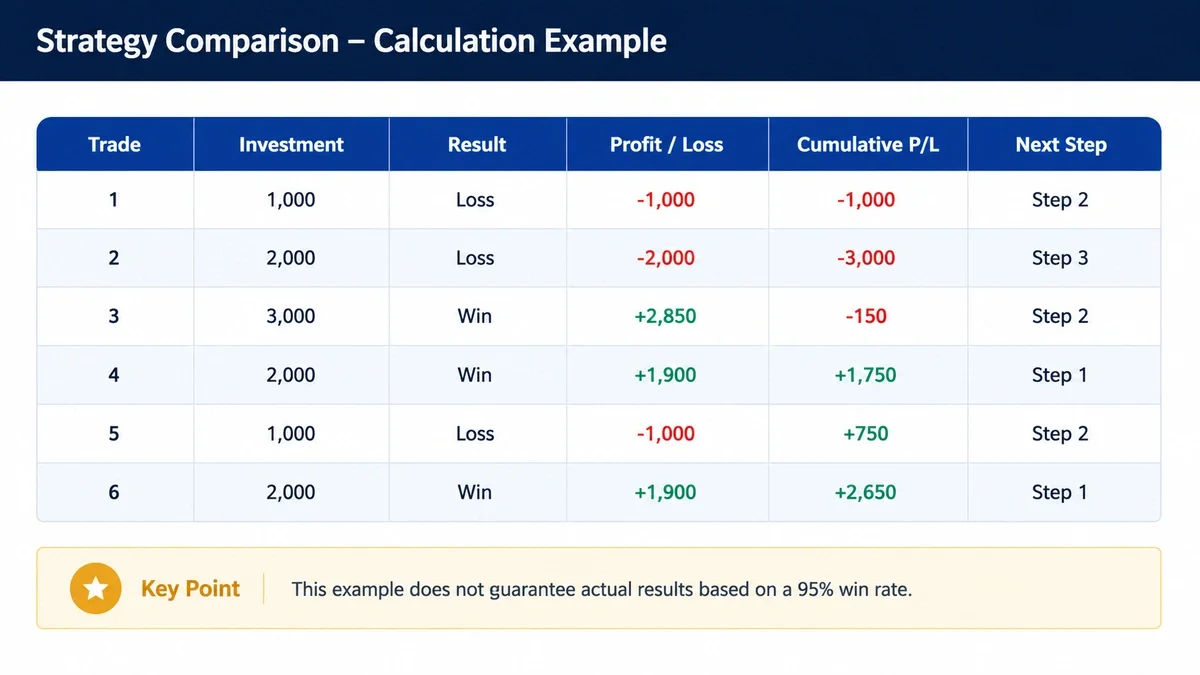
Assume the base amount is 1,000 and the payout rate is 95%.
Let’s look at the following trade sequence:
Loss → Loss → Win → Win → Loss → Win
The investment flow would look like this:
| Trade | Investment Amount | Result | Net Profit/Loss | Cumulative P/L | Next Stage |
|---|
| 1 | 1,000 | Loss | -1,000 | -1,000 | Stage 2 |
| 2 | 2,000 | Loss | -2,000 | -3,000 | Stage 3 |
| 3 | 3,000 | Win | +2,850 | -150 | Stage 2 |
| 4 | 2,000 | Win | +1,900 | +1,750 | Stage 1 |
| 5 | 1,000 | Loss | -1,000 | +750 | Stage 2 |
| 6 | 2,000 | Win | +1,900 | +2,650 | Stage 1 |
This example shows how the D’Alembert strategy adjusts losses and recovery in a stair-step structure.
After two losses, the cumulative result becomes -3,000 and the stage rises to 3. When the third trade wins with 3,000, the profit is +2,850, reducing the cumulative loss to -150. After another win with 2,000, the cumulative result turns positive at +1,750.
The important point is that the payout rate is 95%, not 100%. This means the profit from a winning trade is slightly smaller than the investment amount. Therefore, even when the stage decreases after a win, the actual cumulative result depends on the payout rate.
D’Alembert should always be calculated with the payout condition included.
5. Stage Pressure During Consecutive Losses
D’Alembert is more gradual than Martingale, but consecutive losses can still increase the stage.
With a base amount of 1,000, five consecutive losses may move the next investment amount to 6,000. This is still much smaller than the equivalent Martingale progression, but depending on account size, it can still become a meaningful burden.
For this reason, a maximum stage must be defined in advance.
For example, a trader may decide to allow only up to stage 5. If the next trade would require stage 6, the series ends instead of continuing.
Without a maximum stage, D’Alembert can also turn into an unlimited increase system. The increase is slower than Martingale, but it still rises as losses continue.
In real trading, repeated losses may also signal that the market environment or entry condition is no longer valid. If the same signal continues to fail, it may be more reasonable to stop and review the setup rather than continue increasing the stage.
6. When Does This Strategy Feel Useful?
The D’Alembert strategy may feel useful for traders who find Martingale too aggressive but fixed-amount trading too static.
Because the investment amount changes one step at a time, it creates a sense of structured adjustment. Traders can clearly see the current stage, next investment amount, and recovery path.
It is also useful for traders who want to keep detailed records. By recording the current stage, investment amount, result, cumulative profit/loss, and next stage, traders can easily review how the strategy behaves over time.
However, D’Alembert may feel too slow for traders who want fast profit expansion or immediate recovery. It is not designed to maximize profits aggressively. It is designed to manage investment size more gradually.
This characteristic should be clearly explained to readers so that the strategy is not misunderstood.
7. Comparison with Martingale and Fixed-Amount Trading
Fixed-amount trading uses the same investment amount for every trade. It is simple and stable, but recovery after losses may be slow.
Martingale increases the investment amount rapidly after losses. It may feel powerful because one win can appear to recover previous losses, but the investment burden grows very quickly during losing streaks.
D’Alembert sits between these two approaches.
It increases the investment amount after losses, but not by doubling. It also decreases the amount after wins, but not by resetting immediately to the base amount.
| Strategy | Investment Flow | Characteristic |
|---|
| Fixed-Amount Trading | 1,000 → 1,000 → 1,000 | Simple and stable |
| Martingale | 1,000 → 2,000 → 4,000 | Fast recovery attempt, high pressure |
| D’Alembert | 1,000 → 2,000 → 3,000 | Gradual stage adjustment |
From a blog content perspective, the phrase “a more gradual alternative to Martingale” works well. However, it is better to avoid saying that D’Alembert is “safer.” A more accurate expression is that its increase speed is slower, so the pressure may feel lower.
8. Practical Operating Rules
The first rule is to define the base amount and stage interval. The simplest version uses 1-unit increments. For example, if 1 unit is 1,000, the stages become 1,000, 2,000, 3,000, and so on.
The second rule is to define the maximum stage. Without a maximum stage, the strategy can continue increasing during long losing streaks.
The third rule is to follow the win-decrease rule consistently. If a trade wins, the next investment amount should decrease by one step. If this rule is ignored, the structure becomes inconsistent and difficult to verify.
The fourth rule is to review market conditions after repeated losses. D’Alembert is a money management strategy, not a directional prediction strategy. If the entry signal is poor, changing the investment amount alone cannot solve the problem.
The fifth rule is to record every trade. The record should include:
Trade number
Current stage
Investment amount
Result
Net profit/loss
Cumulative profit/loss
Next stage
This makes the strategy easier to test and evaluate.

9. Real Trading Scenario: A Slow Recovery Structure
The D’Alembert strategy is not designed to recover losses instantly. It works more like a slow recovery structure.
For example, after two consecutive losses, the stage rises. If two wins follow, the stage gradually moves back down and the cumulative result may recover.
This flow feels smoother than Martingale because the investment amount does not jump sharply. However, slow recovery also means that more trades may be required before the cycle fully stabilizes.
This is why the strategy should be explained through the concept of stage adjustment rather than fast recovery.
For readers, this distinction is important. D’Alembert is not a strategy for aggressively chasing losses. It is a method for adjusting position size gradually as results alternate between wins and losses.
10. Situations Where the D’Alembert Strategy May Be Suitable
The D’Alembert strategy may be suitable for traders who feel uncomfortable with the rapid increase of Martingale but want something more dynamic than fixed-amount trading.
It can also be attractive for traders who prefer visible and trackable money management rules. Since the investment amount moves one step at a time, it is easy to understand the current position of the strategy.
The strategy is also useful for long-term record keeping. By tracking current stage, next stage, and cumulative profit/loss, traders can evaluate whether their entry conditions are producing a flow that can realistically recover over time.
However, D’Alembert may not work well in highly volatile or directionless market conditions where wins and losses become unstable. In those environments, the stage may keep moving up and down without producing a clean recovery flow.
For this reason, it is better to test the strategy under specific assets, timeframes, and entry conditions before discussing real application.
11. Recommended Operation Summary
The core operating principles of the D’Alembert strategy are:
Keep the base amount small.
Define the maximum stage clearly.
Increase by one step after a loss.
Decrease by one step after a win.
Stop or review the setup after repeated losses.
The strategy is especially suitable for demo testing because stage movement is easy to record. A simple table can show how the stage rises after losses and falls after wins.
In blog content, the D’Alembert strategy should be positioned as a more gradual alternative to Martingale, but not as a guaranteed safe strategy. Even gradual strategies can become risky if no limits are defined.
A practical test model may look like this:
Base amount: 1,000
Stage interval: 1,000
Maximum stage: 5
Payout rate: 95%
Stop rule: stop if the maximum stage is reached or if market conditions become unstable
This gives readers a clear and realistic starting point for demo testing.
12. How to Verify the Strategy: Final-Stage Participation Rate
When verifying the D’Alembert strategy, looking only at the win rate is not enough.
The most important indicators are the average stage and maximum stage.
If the average stage remains low, the strategy may be operating in a relatively stable way. If the maximum stage is frequently reached, it may suggest that the entry conditions or market environment need to be reviewed.
The same win rate can produce very different results depending on how wins and losses are distributed. If losses cluster together, the stage rises. If wins and losses are more balanced, the stage may remain lower.
During demo testing, traders should record:
Current stage
Trade result
Next stage
Cumulative profit/loss
Maximum stage reached
Number of trades required to return to stage 1
This helps show how gradual the D’Alembert strategy really feels compared with Martingale.
13. Key Points to Emphasize in Content
The main keyword for D’Alembert content is gradual stage adjustment.
The strategy does not aim for the fast recovery style of Martingale. Instead, it provides a more measured way to adjust investment amounts after wins and losses.
The key points worth emphasizing are:
The investment amount increases by only one step after a loss.
The investment amount decreases by one step after a win.
The current stage is easy to track.
It may feel less aggressive than Martingale.
Maximum stage limits are still essential.
The tone of the article should focus on controlled money management rather than aggressive profit expansion. This makes the content more trustworthy and easier for readers to understand.
14. D’Alembert Strategy Exit Criteria
Because D’Alembert moves up and down by stages, deciding when to end a series is important.
There are two common exit approaches.
The first is the conservative exit. In this method, the trader ends the session as soon as the cumulative profit turns positive. This approach focuses on securing recovery rather than continuing the full stage process.
The second is the full-stage return approach. In this method, the trader continues until the investment amount returns to the base stage. This follows the strategy more strictly, but it may require additional trades.
Both approaches have advantages and disadvantages.
The conservative exit may reduce risk after recovery, but it may also end the cycle before the stage fully returns to normal. The full-stage return approach is more consistent with the original structure, but it can expose the trader to additional trades.
For blog content, explaining this choice adds depth. Instead of only saying “increase after a loss and decrease after a win,” the article can help readers think about whether they should exit when the cumulative result turns positive or continue until the base stage is reached.
15. D’Alembert Strategy Demo Testing Routine
To truly understand the D’Alembert strategy, reading the explanation is not enough. Traders should test the same conditions repeatedly in a demo account.
The following conditions should be fixed before testing:
Base amount
Stage interval
Maximum stage
Payout rate
Stop rule
Exit rule
It is recommended to record at least 30 to 50 simulated trade flows.
During testing, recording only the final result is not enough. Each trade should include:
Investment amount
Result
Net profit/loss
Cumulative profit/loss
Current stage
Next stage
Exit decision
Since money management is the core of the D’Alembert strategy, it is also useful to compare it with fixed-amount trading using the same entry signals.
This comparison helps determine whether the strategy actually improves the trading flow or simply increases the size of fluctuations.
16. Conditions to Check Before Applying the D’Alembert Strategy
The first condition is the payout rate. If the payout rate is low, the final cumulative result can change significantly even when the same win/loss sequence occurs.
The second condition is the market environment. In periods of extreme volatility or frequent directional changes, most money management strategies can perform poorly. The quality of the entry signal and market condition matters more than the money management method itself.
The third condition is trader personality. Even though D’Alembert increases more slowly than Martingale, the investment amount can still grow during consecutive losses. Traders who feel strong pressure when stages rise may find the strategy uncomfortable.
The fourth condition is discipline. The strategy only works meaningfully when the trader follows the predefined stage and stop rules.
For this reason, the D’Alembert strategy should always be explained together with demo testing, small base amounts, and maximum stage limits.
17. Final Recommended Position
The D’Alembert strategy is not a formula that guarantees profit. It is a money management framework that organizes how investment amounts move after wins and losses.
Its advantage is that it offers a more gradual structure than Martingale. However, its effectiveness still depends on proper direction analysis, trading timing, asset selection, payout conditions, and stop rules.
For blog content, the best approach is to avoid exaggeration and use concrete numbers. Readers can understand the strategy more clearly when they see how the investment amount changes from a base amount of 1,000 and how cumulative profit/loss develops over several trades.
The final recommendation is clear:
The D’Alembert strategy becomes meaningful when traders first verify the structure through demo testing, keep the base amount small, define the maximum stage, and operate only within predefined stop conditions.
Presented this way, the article becomes more than a simple strategy introduction. It becomes a complete SEO-focused strategy guide that explains both the appeal and the limitations of gradual money management.
Frequently Asked Questions
Q. What is the D’Alembert strategy?
A. It is a money management strategy that increases the investment amount by one step after a loss and decreases it by one step after a win.
Q. Is D’Alembert safer than Martingale?
A. The increase speed is more gradual than Martingale, but consecutive losses can still push the stage higher. Therefore, it cannot be described as risk-free.
Q. Does the strategy reset to the base amount after a win?
A. No. Unlike Martingale, D’Alembert decreases the investment amount by one step after a win instead of immediately resetting to the base amount.
Q. What is the most important rule?
A. The most important rules are defining the base amount, maximum stage, and stop criteria before trading.
Q. Who is this strategy suitable for?
A. It may be suitable for traders who find Martingale too aggressive but want a more structured approach than fixed-amount trading.
Set your base amount and payout rate in a demo account, then directly compare the actual investment flow of the Binary Options 1-3-2-6 Strategy with the more conservative 1-3-2-4 variation.
Try It in Demo
Next Article:
Complete Guide to the Binary Options D’Alembert Strategy
Risk Disclosure
Binary options and derivative trading involve the risk of losing principal and may not be suitable for all investors. The calculation examples in this article are assumptions designed to help explain the structure of the strategy. Actual results may vary depending on trading conditions, payout rates, execution environment, asset volatility, and the user’s entry criteria. This content is intended for general informational purposes only and does not guarantee specific profits or provide investment advice.
 Trade
Trade