A small-target money management strategy that focuses on completing each series with a modest +1 unit profit.
Index
1. What Is Oscar’s Grind?
2. Why the +1 Unit Target Matters
3. Basic Operation Flow
4. Adjusting the Target Amount with a 95% Payout Rate
5. Series Flow Through Multiple Scenarios
6. How Is It Different from Labouchere?
7. Why It Feels More Gradual Than Martingale
8. Who Is This Strategy Suitable For?
9. Practical Operating Rules
10. Real Trading Scenario: When the Series Is Close to the Target
11. Recommended User Profile for Oscar’s Grind
12. Recommended Operation Summary
13. How to Verify the Strategy: Number of Trades Required to Reach the Target
14. Key Points to Emphasize in Content
15. Oscar’s Grind Strategy Demo Testing Routine
16. Final Recommended Position
17. Final Recommended Position
18. Frequently Asked Questions
19. Risk Disclosure
Complete Guide to the Binary Options Oscar’s Grind Strategy: Money Management Based on Repeating Small Targets
Oscar’s Grind is a money management strategy that focuses on reaching a small target within each trading series. In most explanations, the target is set at +1 unit.
Rather than trying to create a large profit in one series, Oscar’s Grind focuses on repeating small targets and gradually building cumulative results.
This strategy is different from systems that aggressively increase investment amounts after losses. After a loss, the investment amount often stays the same. After a win, the next investment amount is adjusted based on whether the series has reached the target.
The core question is simple:
Can this series be completed with a +1 unit result?
In binary options, this question needs to be handled carefully because the payout rate is usually below 100%. With a 95% payout rate, winning a 1,000 trade does not produce +1,000 profit. It produces +950. Because of this, Oscar’s Grind requires more precise adjustment near the end of the series.
In this guide, we will cover the basic structure of Oscar’s Grind, practical examples using a base amount of 1,000 and a 95% payout rate, how to adjust the final investment amount, how it differs from Labouchere, and what operating rules should be checked before using it.
The target of one series is usually set at +1 unit.
After a loss, the same investment amount is often maintained.
After a win, the next investment amount is adjusted based on the remaining amount needed to reach the target.
With a 95% payout rate, final investment adjustment may be needed to reach the +1 unit target.
Oscar’s Grind requires less number-sequence management than Labouchere, but the series can become longer.
The key is to repeat small targets while keeping clear stop rules.
1. What Is Oscar’s Grind?
Oscar’s Grind is a money management strategy that adjusts investment amounts until a small target profit is reached within one series.
The most common target is +1 unit.
If the base amount is 1,000, then one unit equals 1,000, and the target for one series becomes +1,000.
This strategy does not aim to create a large profit from one aggressive recovery sequence. Instead, it focuses on completing one series with a small positive result and then starting again.
If a loss occurs, the strategy does not usually increase the investment amount sharply. In many cases, the same amount is maintained. If a win occurs, the trader checks the cumulative profit/loss and calculates how much more is needed to reach the +1 unit target.
Because of this structure, Oscar’s Grind can feel like a conservative target-based series strategy. It is less about recovering losses quickly and more about managing each series until it can close with a small target profit.
2. Why the +1 Unit Target Matters
The +1 unit target is the central reference point of Oscar’s Grind.
Because the target is small, the exit rule becomes clear. Once the series reaches the target, the trader stops the series instead of continuing to chase additional profit.
This simple exit rule is one of the most important strengths of the strategy.
Without a target, a trading series can easily become too long. If the trader keeps thinking, “just one more trade,” the advantage of Oscar’s Grind disappears. The strategy is not designed to keep trading endlessly. It is designed to complete one small target and then reset.
For blog content, this point should be emphasized clearly. Oscar’s Grind should not be presented as a strategy that guarantees large profits. It is better explained as a strategy that manages trading flow by setting a small series target.
This makes the strategy feel more realistic, structured, and easier to test.
3. Basic Operation Flow
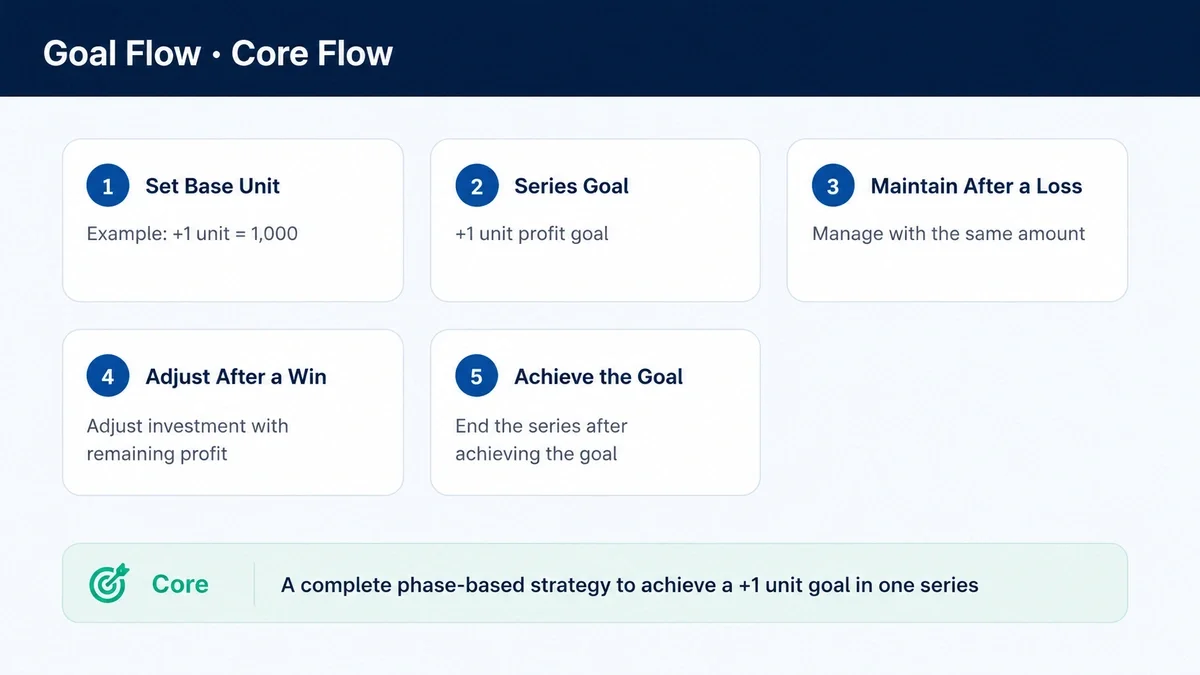
The first step is to define the base amount.
For example, assume 1 unit is 1,000.

The second step is to define the series target.

In this case, the target is +1,000.

The third step is to start the first trade with 1,000.
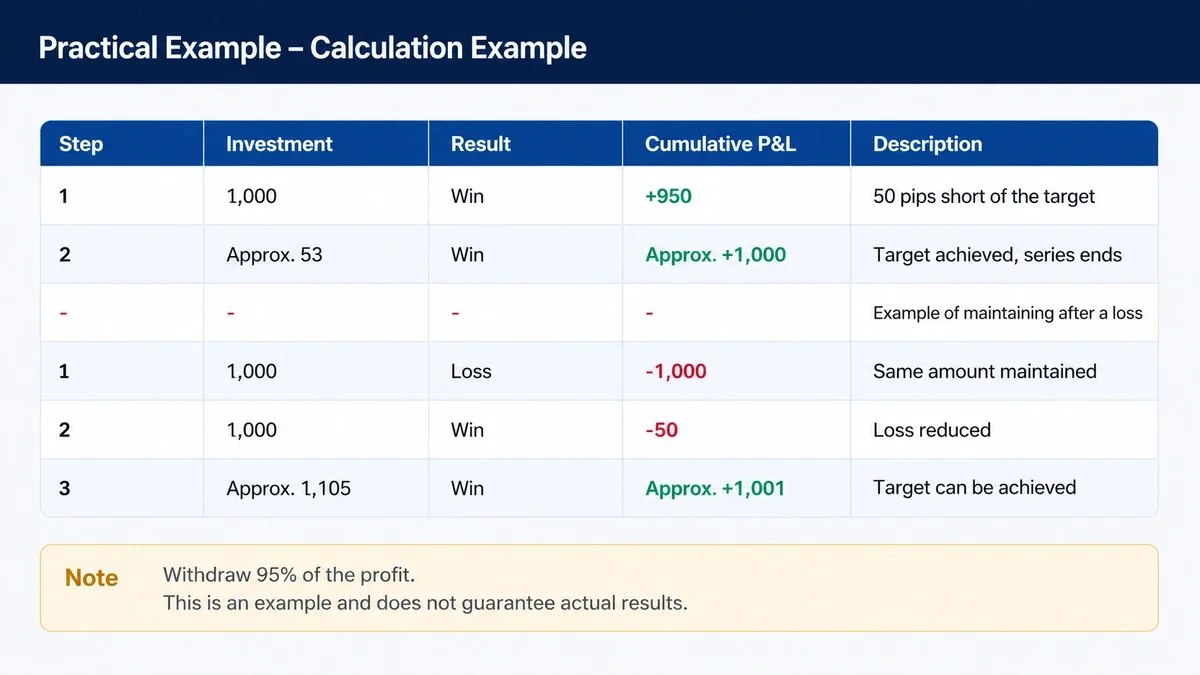
If the first trade loses, the cumulative result becomes -1,000. In many Oscar’s Grind examples, the next trade remains at 1,000.
If the next trade wins, the profit is +950 with a 95% payout rate. The cumulative result becomes -50.
At this point, the trader checks how much more is needed to reach the target. Since the target is +1,000 and the current result is -50, the series still needs +1,050.
This is where Oscar’s Grind becomes different from simple fixed-amount trading. The next investment is not increased emotionally. It is adjusted based on the remaining amount required to reach the series target.
For this reason, Oscar’s Grind is best understood as a target-based series management strategy.
4. Adjusting the Target Amount with a 95% Payout Rate
If the payout rate were 100%, reaching a +1 unit target would be straightforward. However, with a 95% payout rate, a 1,000 winning trade produces only +950 in net profit.
This means that even if the first trade wins, the trader is still 50 short of the +1,000 target.
To add approximately +50 with a 95% payout rate, the required investment amount is about 53.
Since:

53 × 0.95 = 50.35

the series would slightly exceed the +1,000 target.

However, in a real platform, the minimum investment unit may be 100. In that case, the trader may place a 100 trade, gain +95, and end the series with approximately +1,045.

Now consider a different scenario.
If the first trade loses and the second trade wins with 1,000, the cumulative result becomes:

-1,000 + 950 = -50

The target is +1,000, so the remaining amount needed is +1,050.

With a 95% payout rate, the required investment amount is approximately:

1,050 ÷ 0.95 = 1,106
If this trade wins, the profit is approximately +1,050.7, allowing the series to close slightly above the +1,000 target.
This is one of the most important practical points in Oscar’s Grind. The final investment amount may need to be adjusted according to the payout rate and the platform’s minimum investment unit.
5. Series Flow Through Multiple Scenarios
Oscar’s Grind becomes easier to understand when viewed through different series scenarios.
In the immediate-win scenario, the trader starts with 1,000 and wins. The cumulative profit becomes +950. Since the target is +1,000, the series is not technically complete yet. If the platform allows a small adjustment trade, the trader can invest around 53. If the platform minimum is 100, a 100 trade can be used to exceed the target.
In this case, the series is short and the burden is low.
In the loss-then-win scenario, the first 1,000 trade loses and the second 1,000 trade wins. The cumulative result becomes -50. The trader now needs approximately +1,050 more to reach the target. With a 95% payout rate, the next investment amount can be adjusted to approximately 1,106.
This example shows how Oscar’s Grind uses payout-based target adjustment rather than simple aggressive doubling.
However, if losses continue, the series can become longer. Oscar’s Grind does not usually increase investment amounts as sharply as Martingale, but a longer series can still create pressure through accumulated losses and time spent in the series.
Therefore, maximum trade count and maximum loss limits are essential.
6. How Is It Different from Labouchere?
Labouchere uses a number sequence to manage target profit.
The next investment amount is calculated by adding the first and last numbers of the sequence. After a win, those numbers are removed. After a loss, the investment amount is added to the end of the sequence.
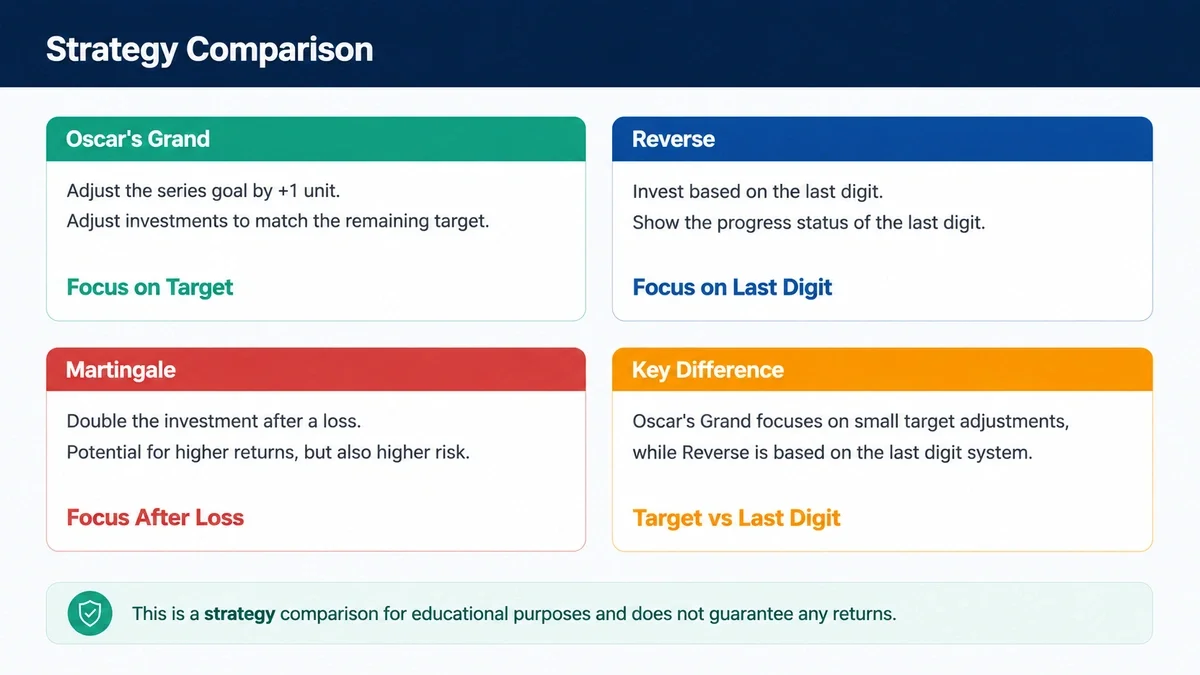
Oscar’s Grind is different because it does not rely on a number sequence. Instead, it focuses on reaching a +1 unit target within the current series.
Labouchere can be described as a number-sequence-based target profit strategy.
Oscar’s Grind can be described as a +1 unit target-based series strategy.
Both strategies deal with target profit, but the management style is different.
Labouchere can become difficult when the number sequence grows longer. Oscar’s Grind can become difficult when the series itself becomes too long.
For blog content, Oscar’s Grind works well after introducing Labouchere. Readers can compare two different target-based approaches:
one that uses a number sequence,
and one that focuses on a small +1 unit target.
7. Why It Feels More Gradual Than Martingale
Oscar’s Grind feels more gradual than Martingale because it does not double the investment amount after losses.
In Martingale, the sequence may quickly become:

1,000 → 2,000 → 4,000 → 8,000
Oscar’s Grind usually maintains the same amount after a loss or adjusts the next amount based on the remaining target.
This can make the strategy feel much less aggressive.
However, being gradual does not mean the strategy is risk-free. The main risk of Oscar’s Grind is not explosive investment growth. The main risk is that the series may become long and accumulated losses may build before the target is reached.
This distinction is important.
Oscar’s Grind should not be introduced as simply “safe.” It should be introduced as a small-target strategy that may reduce aggressive investment growth but still requires limits on series length and cumulative loss.
8. Who Is This Strategy Suitable For?
Oscar’s Grind may be suitable for traders who prefer repeating small targets instead of aiming for large profits in one series.
It can appeal to users who feel more comfortable ending a series once a clear +1 unit target is reached.
It is also suitable for traders who want a clear trading routine. The strategy has a simple structure:
start the series,
manage the cumulative result,
reach the small target,
then stop.
This can help reduce emotional overtrading if the trader follows the target rule strictly.
On the other hand, Oscar’s Grind may feel too slow for traders who want fast profit expansion. It may also feel less attractive to traders who want to recover losses quickly after a losing streak.
Oscar’s Grind is not a “big win” strategy. It is a small-target repetition strategy.
9. Practical Operating Rules
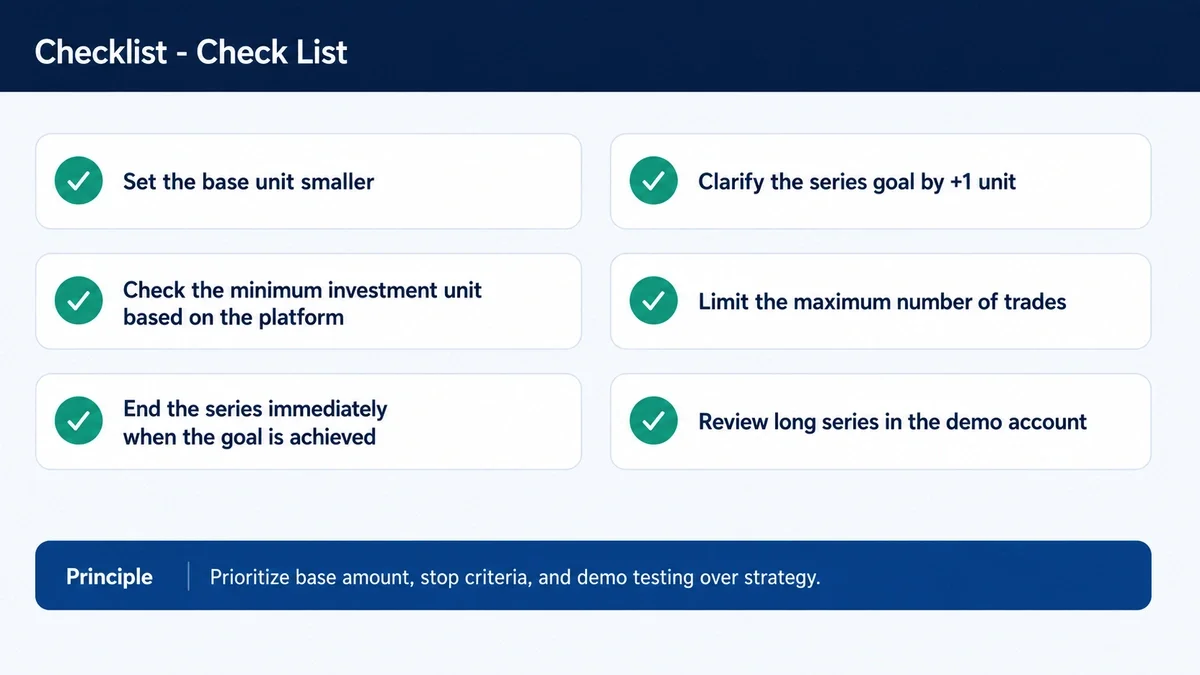
The first rule is to clearly define the base amount and the +1 unit target.
The second rule is to calculate the final adjustment amount based on the payout rate.
The third rule is to consider the platform’s minimum investment amount. If the theoretical required amount is smaller than the minimum trade size, the trader may need to slightly exceed the target.
The fourth rule is to define the maximum number of trades in one series.
The fifth rule is to define the maximum loss allowed in one series.
The sixth rule is to stop immediately once the target is reached. Oscar’s Grind is not a strategy for continuing after the target is completed.
The seventh rule is to review the setup if the series becomes too long. If the same entry condition continues to fail, the issue may be the market environment or the entry signal rather than the money management structure.
For blog content, Oscar’s Grind should be positioned as a strategy that repeats small targets. Adding payout-adjustment examples makes the article more useful than a simple strategy overview.
10. Real Trading Scenario: When the Series Is Close to the Target
One of the most important practical situations in Oscar’s Grind is when the series is close to the target.
For example, assume the base amount is 1,000, the target is +1,000, and the payout rate is 95%.
If the current cumulative profit is +950, the series still needs +50 to reach the target.
Theoretically, the required investment amount is:
50 ÷ 0.95 = approximately 53
If the platform minimum trade size is 100, the trader may use 100 instead. A 100 winning trade produces +95, and the series ends at +1,045.
This type of adjustment is what makes Oscar’s Grind practical.
It is not simply about repeating the same investment amount. It is about checking how much remains until the target and adjusting the final trade accordingly.
For this reason, the article should emphasize not only “stop when the target is reached,” but also “calculate the final investment amount when the series is close to the target.”
This is one of the most important differences between Oscar’s Grind and other money management strategies.
11. Recommended User Profile for Oscar’s Grind
Oscar’s Grind is suitable for users who like repeating small, clear targets.
It may fit traders who do not want to aim for a large daily result in one aggressive series. Instead, they may prefer completing one +1 unit series and then starting again under the same rules.
It can also help users who need a simple exit rule to avoid emotional continuation. Since the target is small and clear, it is easier to stop after completion.
However, Oscar’s Grind may not be suitable for traders who want rapid loss recovery or strong profit expansion during winning streaks.
Compared with strategies like Martingale or Paroli, Oscar’s Grind has a more modest identity. It is designed around routine, small targets, and controlled series management.
12. Recommended Operation Summary
A practical Oscar’s Grind test should begin with a fixed base amount and a fixed +1 unit target.

For example:

Base amount: 1,000
Target: +1,000
Payout rate: 95%
Maximum trades per series: 5
Maximum loss per series: -3,000
This kind of simple limit helps traders test the strengths and weaknesses of the strategy quickly.
The trader should also prepare rules for the final adjustment trade. If the series is close to the target, the next investment amount should be calculated based on the remaining target amount and the payout rate.
Oscar’s Grind should be positioned as a conservative target-based strategy. It is not a strong recovery strategy like Martingale, and it is not a winning-streak expansion strategy like Paroli. Its identity is clear:
small target,
clear exit,
repeatable series structure.
13. How to Verify the Strategy: Number of Trades Required to Reach the Target
When testing Oscar’s Grind, it is not enough to check whether the target was reached.
The number of trades required to reach the target is equally important.
A series that reaches +1 unit in two trades feels very different from a series that takes eight trades. Even if both series end with a similar profit, the psychological burden and time exposure are not the same.
Traders should also record series that fail to reach the target.
If many series are stopped because they hit the maximum trade count or maximum loss limit, the strategy may be taking longer than expected to complete.
Important data points include:

Base amount
Target amount
Number of trades in the series
Final adjustment investment
Reason for exit
Cumulative profit/loss
This data helps traders evaluate whether Oscar’s Grind is truly suitable as a small-target repetition strategy.
14. Key Points to Emphasize in Content
The core message of Oscar’s Grind content is:
repeat small targets.
This strategy is more persuasive for readers who care about routine, structure, and clear exit criteria than for readers looking for aggressive profit growth.
The key points worth emphasizing are:
The target is clear.
The strategy focuses on +1 unit per series.
Final investment can be adjusted based on payout rate.
It feels more gradual than Martingale.
Series length must still be controlled.
It is also useful to connect Oscar’s Grind with Labouchere. Labouchere is a number-sequence target strategy, while Oscar’s Grind is a +1 unit target strategy. Comparing the two helps readers understand the broader category of target-based money management strategies.
15. Oscar’s Grind Strategy Demo Testing Routine
To understand Oscar’s Grind properly, reading the explanation is not enough. Traders should test the same conditions repeatedly in a demo account.
Before testing, the following conditions should be fixed:

Base amount
Target amount
Payout rate
Maximum number of trades per series
Maximum loss per series
Final adjustment rule
Exit rule
It is recommended to record at least 30 to 50 simulated trading series.
During testing, recording only the final result is not enough. Each trade should include:

Investment amount
Result
Net profit/loss
Cumulative profit/loss
Remaining amount to target
Next investment decision
Reason for ending the series
Since the core of Oscar’s Grind is target management, the remaining amount to the target should always be recorded.
It is also useful to compare the same entry signals with fixed-amount trading. This helps determine whether Oscar’s Grind actually improves the trading flow or simply makes the series longer.
16. Conditions to Check Before Applying Oscar’s Grind
Oscar’s Grind is not a formula that guarantees profit. It is a money management framework that organizes trading around small series targets.
Its advantage is that the target is simple and the exit rule is clear. However, the strategy only becomes meaningful when combined with appropriate market direction analysis, suitable trading timing, asset selection, payout conditions, and strict stop rules.
For blog content, the best approach is to avoid exaggeration and show concrete examples. Readers can understand the strategy more easily when they see how a base amount of 1,000, a target of +1,000, and a 95% payout rate affect the actual final investment adjustment.
The final recommendation is clear:
Oscar’s Grind should first be verified through demo testing, using a small base amount, a +1 unit target, a maximum trade count, and a maximum loss limit.
Presented this way, the article becomes more than a simple strategy introduction. It becomes a complete SEO-focused strategy guide that explains both the appeal and the limitations of small-target money management.
17. Final Recommended Position
Oscar’s Grind is not a formula that guarantees profit. It is a money management framework that organizes trading around small series targets.
Its advantage is that the target is simple and the exit rule is clear. However, the strategy only becomes meaningful when combined with appropriate market direction analysis, suitable trading timing, asset selection, payout conditions, and strict stop rules.
For blog content, the best approach is to avoid exaggeration and show concrete examples. Readers can understand the strategy more easily when they see how a base amount of 1,000, a target of +1,000, and a 95% payout rate affect the actual final investment adjustment.
The final recommendation is clear:
Oscar’s Grind should first be verified through demo testing, using a small base amount, a +1 unit target, a maximum trade count, and a maximum loss limit.
Presented this way, the article becomes more than a simple strategy introduction. It becomes a complete SEO-focused strategy guide that explains both the appeal and the limitations of small-target money management.
Frequently Asked Questions
Q. What is Oscar’s Grind?
A. Oscar’s Grind is a money management strategy that usually aims to complete one series with a +1 unit profit.
Q. Why is adjustment needed with a 95% payout rate?
A. Because a 1,000 winning trade produces only +950 profit. To reach a +1,000 target, an additional adjustment trade may be needed.
Q. How is it different from Labouchere?
A. Labouchere uses a number sequence to manage target profit, while Oscar’s Grind focuses on reaching a +1 unit target within one series.
Q. What is the biggest risk?
A. The biggest risk is that the series can become long and cumulative losses can increase before the target is reached.
Q. Is Oscar’s Grind more conservative than Martingale?
A. It generally feels more gradual because it does not double the investment amount after losses. However, it still requires maximum trade count and loss limits.
Set your base amount and payout rate in a demo account, then directly compare the actual investment flow of the Binary Options Oscar’s Grind Strategy.
Try It in Demo
Next Article:
Complete Guide to the Binary Options Kelly Criterion Strategy
Risk Disclosure
Binary options and derivative trading involve the risk of losing principal and may not be suitable for all investors. The calculation examples in this article are assumptions designed to help explain the structure of the strategy. Actual results may vary depending on trading conditions, payout rates, execution environment, asset volatility, and the user’s entry criteria. This content is intended for general informational purposes only and does not guarantee specific profits or provide investment advice.
 Trade
Trade