Pratonton
menu
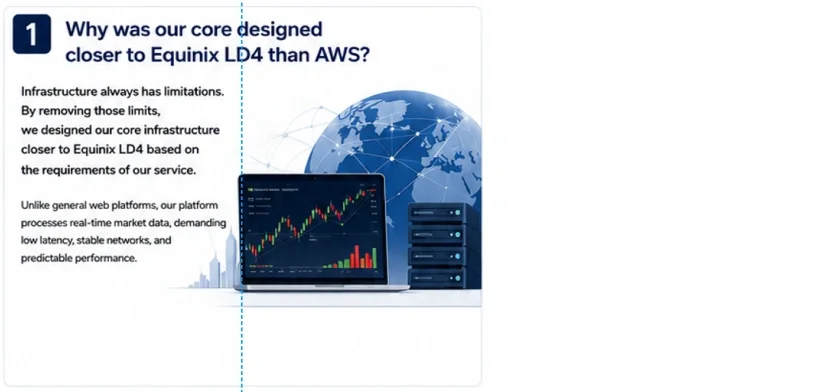
Why was our platform’s core architecture designed closer to Equinix LD4 rather than AWS?
Today, cloud platforms are usually the first infrastructure option considered for most services.
They allow rapid scaling on demand, provide access to a wide range of managed services, and simplify operational automation. These advantages are exactly why AWS has become the de facto standard for many organizations.
However, infrastructure design always follows the same principle:
The right choice is not the most generic or widely adopted option, but the one that best aligns with the core requirements of the service.
Our platform has characteristics that differ from those of a typical web service.
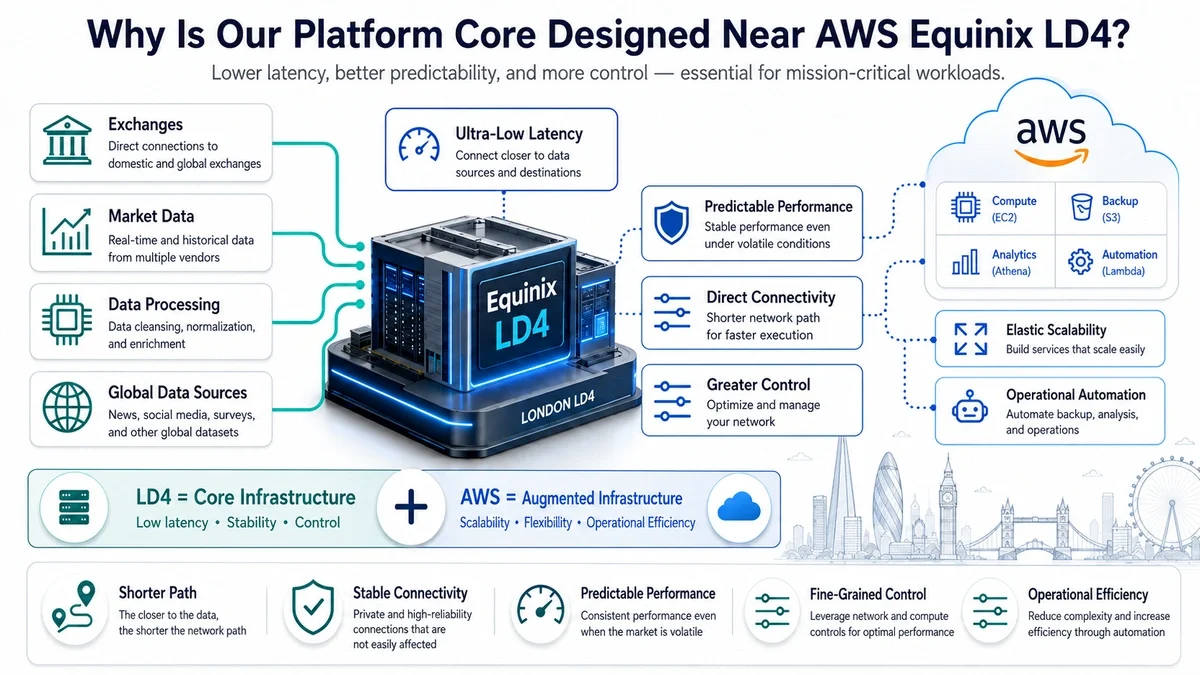
The core requirement is not simply server scalability, but rather low-latency market data ingestion, stable network paths, and predictable performance. Workloads of this nature have requirements that cannot be fully addressed by the advantages of public cloud alone. And that is exactly where an Equinix LD4-based architecture becomes a more suitable choice.
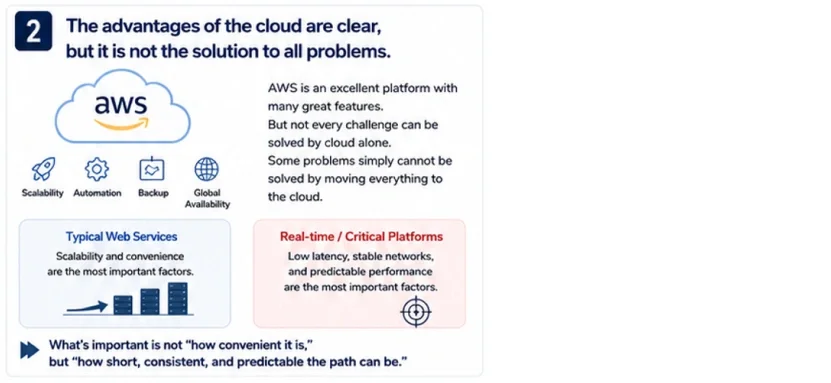
— But It Is Not the Answer to Every Problem AWS is an excellent platform.
It enables rapid service deployment, makes infrastructure-as-code management straightforward, and provides broad support for backup and recovery, global expansion, and operational automation. The reasons many companies choose AWS are entirely reasonable.
However, not every service consumes infrastructure in the same way.
For a typical web application, horizontal scalability and operational convenience may be the most important priorities. But platforms where real-time responsiveness is critical operate under different conditions. In these environments, what matters more than average processing performance is how consistently latency can be maintained, and through which paths data enters and exits the system.
In other words, the key question is not:
“Which environment is more convenient?”
but rather:
“Which environment can provide a shorter, more predictable, and more controllable path?”
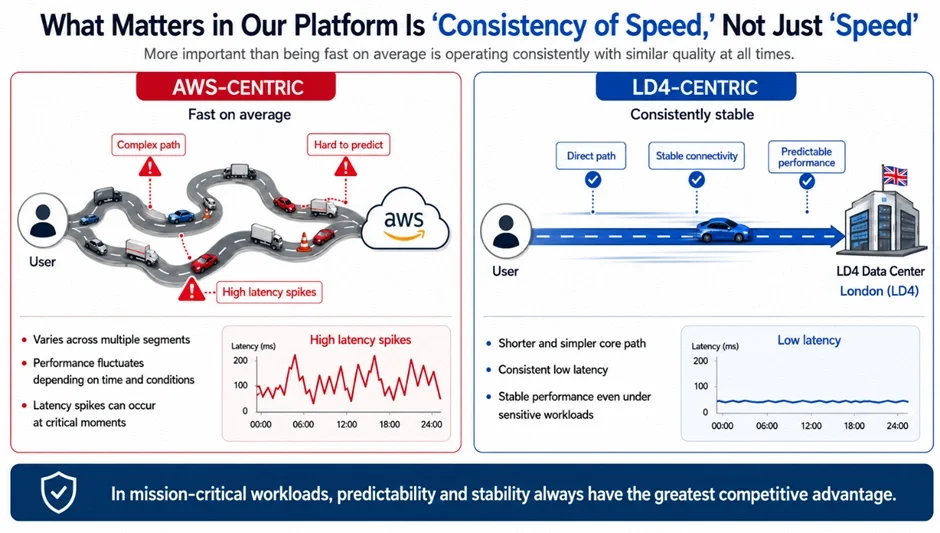
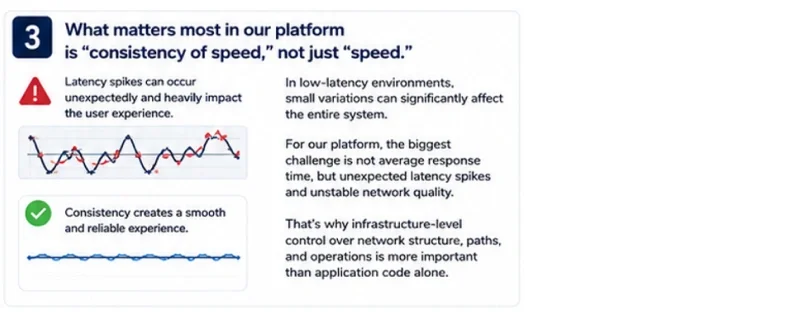
For our platform, what matters is not simply “speed,” but the consistency of speed.
In low-latency environments, simply being fast is not enough.
What matters even more is whether the system can operate at a consistently similar speed at all times.
From a platform perspective, the most difficult challenge is not average response time, but unexpected latency spikes and unstable network quality. In sensitive flows such as market data ingestion or trade execution, even small variations can significantly impact the perceived quality of the entire system.
Because of these characteristics, “predictability” becomes more important than “convenience” for core workloads. And this predictability is rarely solved through application code alone. Ultimately, infrastructure-level decisions — such as network topology, connection paths, and operational control — determine the overall quality of the system.
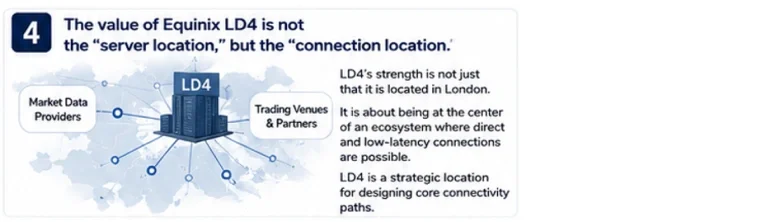
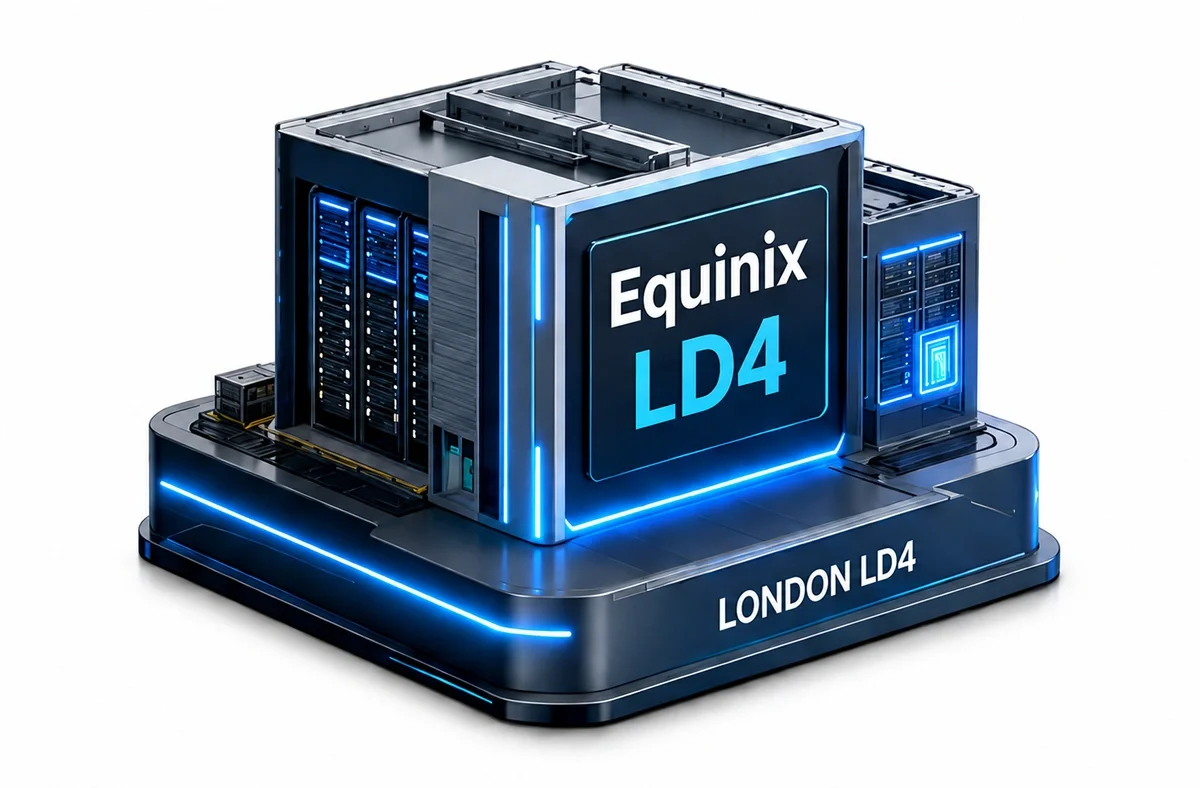
The strength of LD4 is not simply that servers can be placed in London.
What matters more is the ecosystem within which connections can be established.
In low-latency workloads, the key factors are not only CPU specifications or memory size. In practice, service quality is influenced far more by how close the system is to its data sources, how simple the network path is, and how consistently stable the flow can remain without external variability.
From this perspective, LD4 is not merely an IDC facility, but rather a strategic location for designing critical connection paths.
What matters most for our platform is not:
“Where should the servers be located?”
but rather:
“Where can core data flows be received and processed in the most stable and predictable way?”
That is precisely why the answer leads closer to LD4.
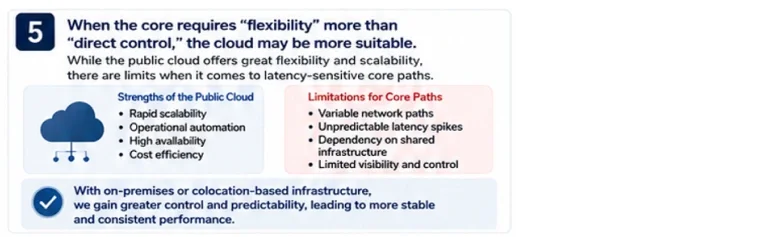
One of the greatest strengths of the public cloud is abstraction.
It allows infrastructure to be provisioned quickly while significantly reducing the amount of physical infrastructure operators must manage directly. For most services, this is a major advantage.
However, for platforms where the quality of the core path is critical, this abstraction can sometimes become a limitation.
The broader the area we can directly observe, directly control, and directly optimize, the greater the advantage becomes.
On-premises or colocation-based architectures are operationally more demanding and require more hands-on management.
In return, they provide much finer control over network configuration, security policies, route design, and performance characteristics. And this level of controllability becomes a real competitive advantage for platforms that require low latency and high consistency.
Ultimately, there is no absolute “better” infrastructure.
The right choice depends on how much control the platform requires.
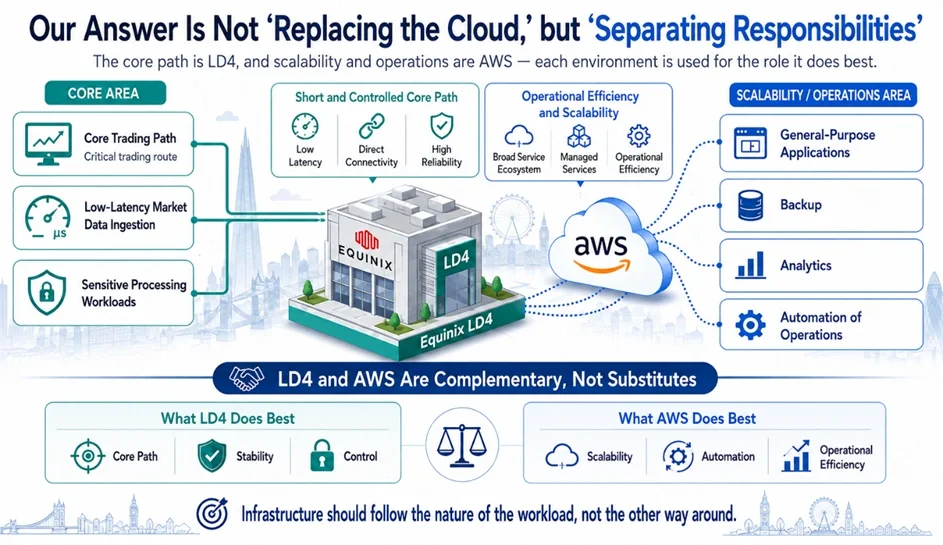
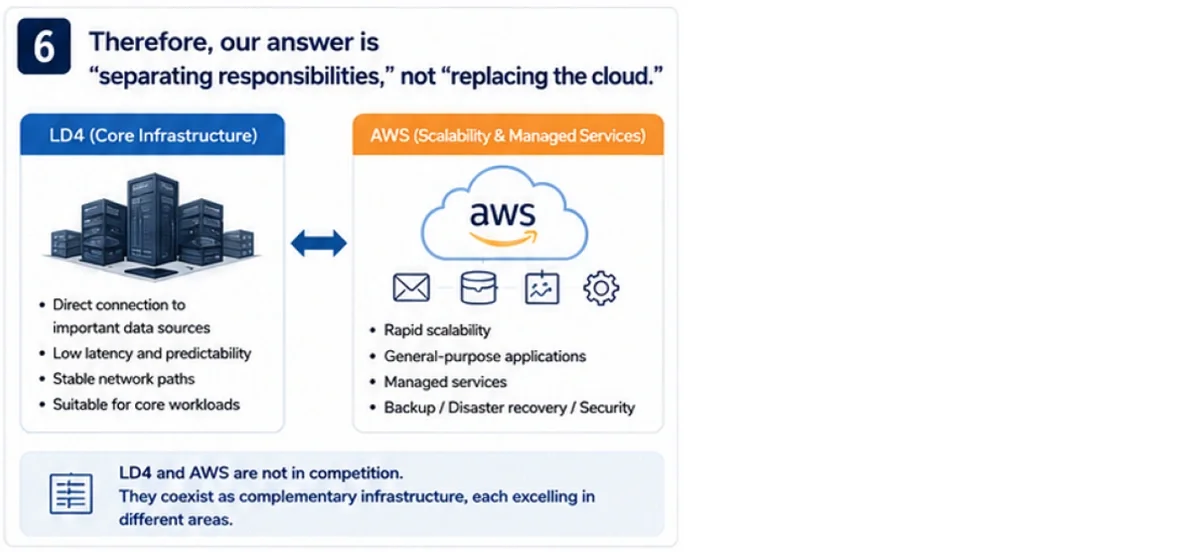
That is why our answer is not “replacing the cloud,” but rather “separating responsibilities.”
At this point, there is one important misunderstanding we want to clarify.
This discussion does not mean that “on-premises infrastructure is always better than AWS.”
In fact, a realistic infrastructure strategy is often the opposite.
What matters more is separating the roles each environment performs best and combining them appropriately based on the nature of the service.
The same principle applies to our platform.
Areas where latency and network path quality are critical — such as core trading paths and low-latency market data ingestion — are better suited to environments like LD4. On the other hand, AWS is extremely effective for rapid scaling, general-purpose application workloads, supporting services, backup, and operational scalability.
In other words, LD4 and AWS are not competing replacements for one another.
They are complementary infrastructures designed to solve different problems.
Technology decisions are often influenced by trends.
Infrastructure decisions are especially susceptible to this.
When everyone is talking about the cloud, choosing something outside the cloud can sometimes appear conservative.
Nevertheless, what truly matters is not the trend, but the nature of the workload.
Unlike a general-purpose web service, our platform prioritizes stable latency characteristics, predictable network paths, and high controllability over raw speed itself. That is why our core infrastructure was designed closer to Equinix LD4 than AWS. This was not the result of a preference for a particular technology, but rather the result of choosing the architecture that best aligns with the actual characteristics of the service.
Good infrastructure is not the infrastructure that uses the newest technologies most aggressively.
Good infrastructure is the infrastructure that most accurately satisfies the characteristics the service actually requires.
AWS remains an extremely powerful platform.
However, what our platform’s core requires is not generalized flexibility, but rather a shorter, more stable, and more directly controllable path. And the answer that aligns more closely with those requirements is Equinix LD4.
Ultimately, the question is simple:
It is not “Which platform is more famous?”
but rather:
“Which platform best protects the core of our service?”
For us, the answer is clear.
For the core platform, LD4 is the better fit.