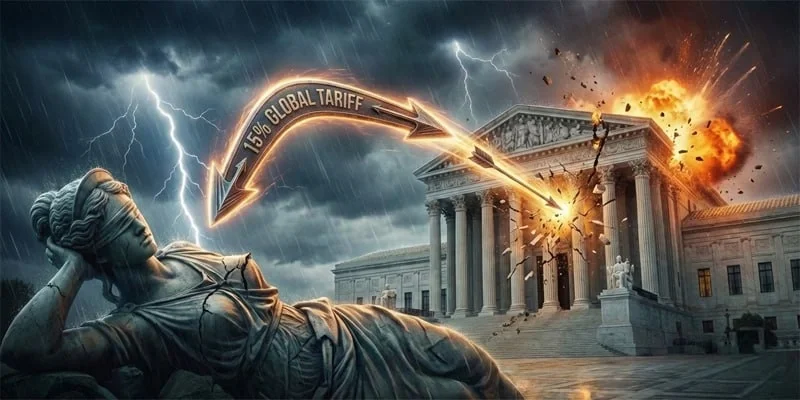
For a brief, shimmering moment on February 20th, the global trade establishment breathed a collective sigh of relief. The U.S. Supreme Court had handed down a landmark ruling, striking down the administration's "Reciprocal Tariffs" as an unconstitutional reach. To the traditionalists, it felt like the rule of law had finally re-established a border around executive overreach, reminding the White House that the power to tax and levy duties belongs exclusively to the halls of Congress, not the Resolute Desk.
However, this was a textbook application of the "Major Questions Doctrine" that backfired with spectacular irony. Even Trump-appointed justices like Neil Gorsuch and Amy Coney Barrett sided with the majority, asserting that the International Emergency Economic Powers Act (IEEPA) did not grant the President a blank check for broad economic taxation. But while the court successfully defended the constitutional separation of powers, it inadvertently triggered a tactical pivot that can only be described as a masterclass in jurisdictional arbitrage.
The relief lasted less than 24 hours before being replaced by a profound sense of regulatory whiplash. Rather than retreating, the administration leveraged the legal setback as a springboard for a more aggressive, universal barrier. The "Reciprocal Tariff" has been discarded, but in its place stands a new, immediate reality: a 15% global tariff on nearly all imports, effective as of February 24th at 00:01. By striking one weapon from the President's hand, the Court has merely forced him to unsheath a sharper, older set of bayonets.
The administration’s response was a classic jeong-myeon dol-pa—a frontal breakthrough. Immediately following the ruling, the President invoked Section 122 of the Trade Act of 1974. The escalation was swift and calculated: an initial 10% global tariff was announced on day one, only to be hiked to the absolute legal maximum of 15% on day two. This rapid-fire maneuvering serves a dual purpose: it signals total defiance to the judicial branch and creates immediate leverage before the international community can process the "win" at the Supreme Court.
Crucially, the strategist must note what the Court didn’t do. While it ruled future IEEPA-based tariffs unconstitutional, it remained silent on the $175 billion in duties already collected. The administration has effectively kept the "spoils" of its first campaign while switching legal vehicles for the second. The President's rhetoric remains unbowed, framing the judiciary as an obstacle to national recovery:
"The Court's decision was absurd and poorly written... For decades, many countries have been extorting the United States without any retaliation until I arrived. We are raising the global tariff to the 15% level, which is completely allowed and legally verified."
The use of Section 122 is a brilliant, if temporary, "strategic bridge." Designed to address balance-of-payments emergencies, Section 122 allows the President to unilaterally impose tariffs of up to 15%—but only for a maximum of 150 days. Beyond that, the clock runs out, and Congressional approval becomes mandatory.
This is not a cooling-off period; it is a ticking clock. The administration is using this 150-day window to buy time for the "Plan B" arsenal. Specifically, the U.S. Trade Representative (USTR) has already initiated Section 301 investigations, which typically take six to twelve months to conclude. By the time the Section 122 timer expires, the administration intends to have its more permanent, investigative-based tariffs ready to go, ensuring there is no gap in the protectionist wall.
The irony of the Supreme Court’s intervention is that it has forced the executive branch to excavate the "saurian" remains of trade law—older, more obscure statutes that carry even more punitive potential than the IEEPA. The administration is currently refining a three-pronged legal offensive:
Counter-intuitively, the financial markets are not panicking. Analysts at Daishin Securities have observed that while the SCOTUS ruling created a momentary blip of volatility, the broader sentiment is one of resilience. This is driven by the "Trump Liquidity" factor: the market believes that the administration’s focus on monetary easing, aggressive deregulation, and fiscal expansion (tax cuts) will provide a high floor for equities, essentially outweighing the drag of higher import costs.
Investors are increasingly adopting a strategy of jeung-si bi-jung-hwang-dae—increasing their stock weightings—despite the geopolitical headwinds. The rationale rests on three pillars:
Perhaps the most surprising aspect of this escalation is the lack of retaliation. Major global players like Korea, Japan, and the EU are choosing "strategic compliance" over trade war escalation.
Korea is moving ahead with its $350 billion U.S. investment plan, and Japan is processing a massive $550 billion investment package. In many ways, these are the "hush money" of modern geopolitics—nations are essentially paying a premium to ensure they remain under the American security umbrella. For the EU, the shadow of the Russia-Ukraine war makes the prospect of a fractured relationship with Washington unthinkable. These allies have concluded that swallowing a 15% tariff is a small price to pay for continued military and security cooperation in an increasingly unstable world.
The Supreme Court ruled on the source of the President's power, but they did not—and perhaps could not—alter the direction of his policy. We have entered a 150-day countdown that marks the end of the predictable, rules-based trade order.
As the administration prepares to transition from temporary "balance-of-payments" measures to the more saurian 50% retaliatory powers of the 1930s, the global trade system is shifting from a foundation of law to a foundation of leverage. In a world where judicial "wins" for free trade only serve to accelerate the deployment of more radical protectionist weapons, is the era of predictable commerce gone for good? If the current 15% ceiling is merely a "bridge," we must prepare for what lies on the other side.