A gradual money management strategy that increases investment by one step after a loss and decreases it by one step after a win.
1. What Is the Labouchere Strategy?
2. Why the Number Sequence Works as a Trading Record
3. How to Design the Initial Number Sequence
4. How the Sequence Changes After Wins and Losses
5. Example Based on a 95% Payout Rate
6. Difference Between Short and Long Number Sequences
7. Comparison with Martingale and D’Alembert
8. Who Is This Strategy Suitable For?
9. Practical Operating Rules
10. Real Trading Scenario: Starting with a Short Sequence
11. Recommended User Profile for the Labouchere Strategy
12. Recommended Operation Summary
13. How to Verify the Strategy: Sequence Length and Completion Rate
14. Key Points to Emphasize in Content
15. Labouchere Strategy Demo Testing Routine
16. Conditions to Check Before Applying the Labouchere Strategy
17. Final Recommended Position
18. Frequently Asked Questions
19. Risk Disclosure
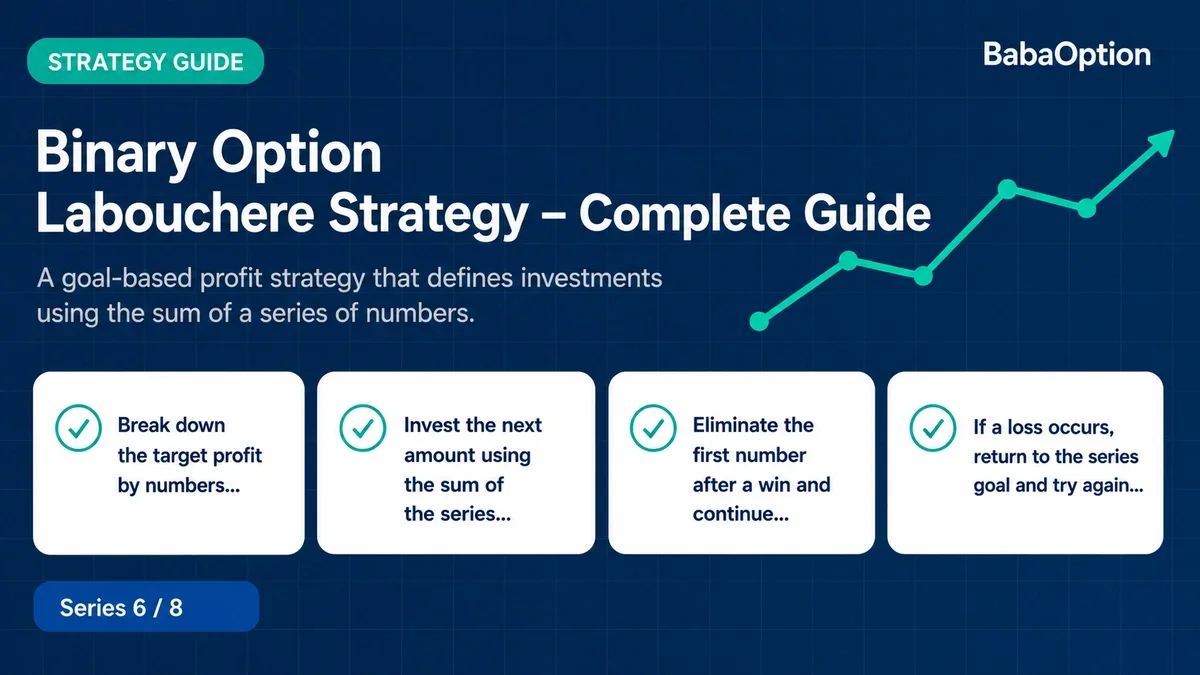
The Labouchere strategy is a money management method that uses a number sequence to manage both the target profit and the progress of a trading series. It is also commonly known as a cancellation system.
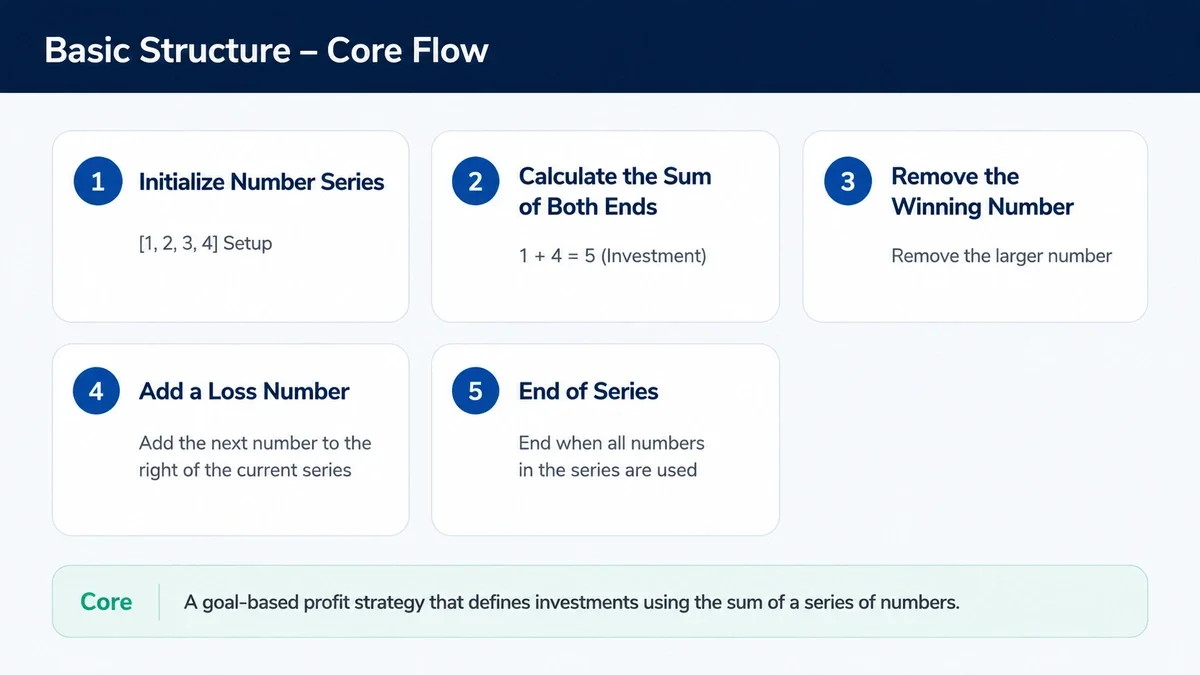
The basic rule is simple. The next investment amount is calculated by adding the first number and the last number in the sequence. If the trade wins, those two numbers are removed. If the trade loses, the investment amount is added to the end of the sequence.
When all numbers disappear from the sequence, one series is completed.
This structure allows traders to visually track whether the strategy is moving closer to the target or whether the burden is increasing due to losses. Unlike simple doubling systems, the next investment amount is not determined only by the previous result. It is determined by the current state of the number sequence.
In this guide, we will cover the core principle of the Labouchere strategy, how to design the initial sequence, how the sequence changes after wins and losses, a practical example based on a 95% payout rate, and how it compares with other money management strategies such as Martingale and D’Alembert.
The next investment amount is calculated by adding the first and last numbers in the sequence.
After a win, the first and last numbers are removed from the sequence.
After a loss, the investment amount is added to the end of the sequence.
When the sequence is fully cleared, the series is completed.
Because binary options payout rates are usually below 100%, the sequence target and actual cumulative profit may differ.
The most important limits are the initial sequence, maximum sequence length, and maximum single investment amount.
The Labouchere strategy is a money management method that divides a target profit into several numbers and uses that sequence to calculate the next investment amount.
For example, if the initial sequence is:

[1, 2, 3, 4]

the total target is 10 units. If the base amount is 1,000, the theoretical target profit can be understood as approximately 10,000.
The first investment amount is calculated by adding the number on the far left and the number on the far right.

In this case:

1 + 4 = 5 units

So, with a base amount of 1,000, the first investment amount becomes 5,000.
If the trade wins, the numbers 1 and 4 are removed from the sequence. If the trade loses, the invested number, 5, is added to the end of the sequence.
This makes Labouchere different from simple multiplier-based strategies. The next investment amount is not based only on whether the previous trade won or lost. It is based on the current number sequence.
For this reason, Labouchere is best explained as a number-sequence-based target profit management strategy.
The most important characteristic of the Labouchere strategy is that the number sequence itself acts as a record of the current series.
If the sequence becomes shorter, it means the trader is moving closer to completing the target. If the sequence becomes longer, it means losses have been added and the burden of the series has increased.
For example, if the initial sequence:

[1, 2, 3, 4]

becomes:

[2, 3]

after a win, the series is closer to completion.

On the other hand, if a loss changes the sequence into:

[1, 2, 3, 4, 5]

the sequence has become longer, and the next investment amount may increase.
This visual structure is what makes Labouchere interesting. The trader can see the condition of the strategy just by looking at the remaining sequence.
Because of this, Labouchere works especially well with detailed record keeping. If traders record the sequence, investment amount, result, and cumulative profit/loss for each trade, they can later review exactly how the series developed.
The initial number sequence is the starting point of the Labouchere strategy.
A simple sequence such as:
[1, 2, 3, 4]
is easy to understand and works well for educational examples.
Some traders may use equal numbers, such as:
[1, 1, 1, 1]
Others may use a more moderate structure such as:
[1, 2, 2, 3]
The larger the total of the initial sequence, the larger the target profit becomes. However, the starting investment amount and the burden of the series may also increase.
For example:
[1, 2, 3, 4] starts with 1 + 4 = 5 units.
[2, 3, 4, 5] starts with 2 + 5 = 7 units.
This means that a larger sequence can create more pressure from the very first trade.
For beginners, it is usually better to start with a short and small sequence. A long sequence may look more detailed, but it can make the series last longer and become more difficult to manage after losses.
Labouchere is not about setting the largest possible target. It is about making the target visible and manageable through a number sequence.
The Labouchere strategy changes the number sequence differently depending on whether the trade wins or loses.
If the trade wins, the first and last numbers are removed.
For example, starting from:
[1, 2, 3, 4]
the first investment amount is:
1 + 4 = 5 units
If this trade wins, the 1 and 4 are removed, leaving:
[2, 3]
The next investment amount becomes:
2 + 3 = 5 units
If this trade also wins, both numbers are removed and the sequence becomes empty. The series is complete.
If the trade loses, the investment amount is added to the right side of the sequence.
For example, if the first 5-unit trade loses, the sequence becomes:
[1, 2, 3, 4, 5]
The next investment amount becomes:
1 + 5 = 6 units
This means a loss not only affects the cumulative profit/loss, but also extends the number sequence.
There is also a special rule when only one number remains. If the sequence is:
[3]
then the investment amount is 3 units. If the trade wins, the number is removed and the series ends.
Explaining this detail is important because it helps readers follow the actual flow of the strategy.
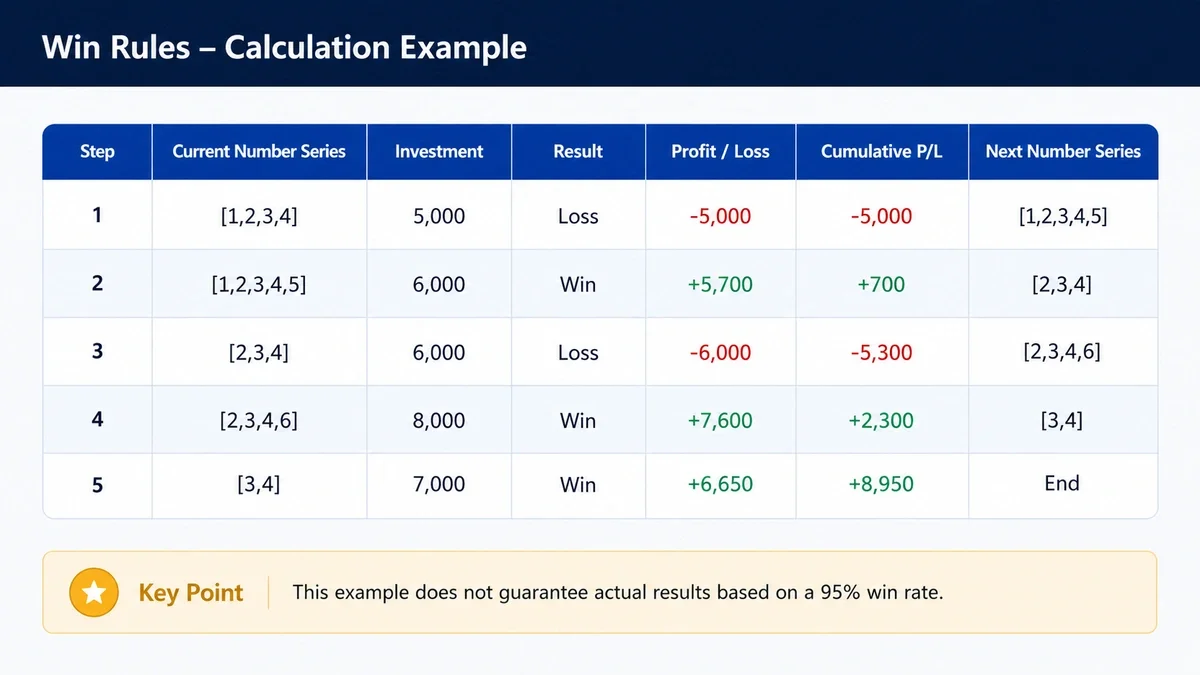
Assume the base amount is 1,000, the initial sequence is:
[1, 2, 3, 4]
and the payout rate is 95%.
The first investment amount is 5,000. If the first trade loses, the cumulative result becomes -5,000 and the sequence changes to:
[1, 2, 3, 4, 5]
The next investment amount is 6,000.
If the second trade wins, the profit is +5,700. The cumulative result becomes +700, and the sequence changes to:
[2, 3, 4]
After that, assume the flow continues as follows:
6,000 loss
8,000 win
7,000 win
The full example looks like this:
| Trade | Starting Sequence | Investment Amount | Result | Cumulative P/L | Next Sequence |
|---|---|---|---|---|---|
| 1 | [1, 2, 3, 4] | 5,000 | Loss | -5,000 | [1, 2, 3, 4, 5] |
| 2 | [1, 2, 3, 4, 5] | 6,000 | Win | +700 | [2, 3, 4] |
| 3 | [2, 3, 4] | 6,000 | Loss | -5,300 | [2, 3, 4, 6] |
| 4 | [2, 3, 4, 6] | 8,000 | Win | +2,300 | [3, 4] |
| 5 | [3, 4] | 7,000 | Win | +8,950 | Completed |
This example shows an important point.
The initial sequence total is 10 units. However, because the payout rate is 95%, the final cumulative profit is not exactly 10,000. In this example, the final result is +8,950.
This is especially important for binary options. Since the payout rate is usually below 100%, the theoretical sequence target and the actual cumulative profit may not match exactly.
Therefore, Labouchere should always be explained with payout rate conditions included.
A short number sequence is easier to manage and usually completes faster.
For example:
[1, 2, 3]
starts with 1 + 3 = 4 units and can shrink quickly after a win.
A longer sequence may create a larger target, but it can also make the series last longer. If losses are added repeatedly, the sequence becomes longer, the next investment amount may grow, and it may take more trades to complete the series.
Long sequences can look more sophisticated, but they can become difficult to manage in real trading.
For beginner-oriented blog content, it is better to explain the strategy using short sequences first. The sequence:
[1, 2, 3, 4]
is useful because it is simple enough to follow while still showing how the system expands and contracts after wins and losses.
Before using longer sequences, traders should test them in a demo account and check whether the investment size and series length remain manageable.
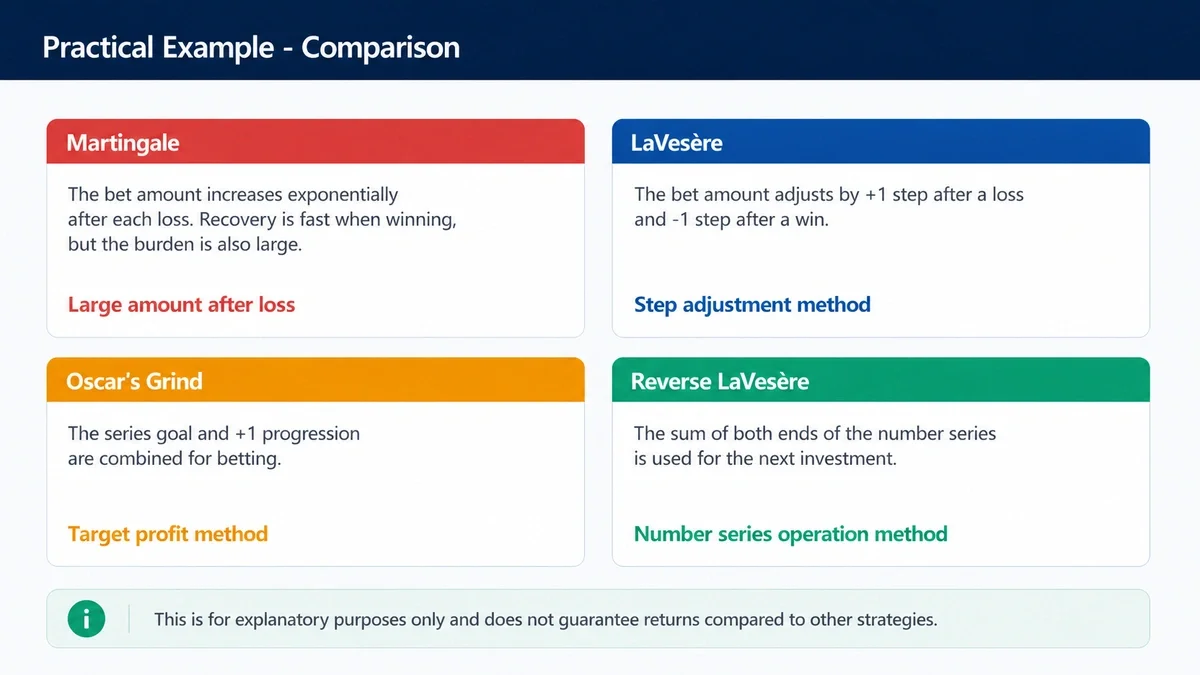
Martingale increases the investment amount after a loss and resets to the base amount after a win.
D’Alembert increases the investment amount by one step after a loss and decreases it by one step after a win.
Labouchere calculates the investment amount by adding the first and last numbers of a sequence.
This makes the three strategies feel very different.
Martingale can be described as a loss-recovery strategy.
D’Alembert can be described as a gradual stage-adjustment strategy.
Labouchere can be described as a number-sequence-based target profit management strategy.
| Strategy | Adjustment Method | Strength | Key Risk |
|---|---|---|---|
| Martingale | Increase after loss | Recovery structure is intuitive | Consecutive losses create heavy pressure |
| D’Alembert | Loss +1 / Win -1 | Gradual stage adjustment | Stages can still rise during long losing streaks |
| Labouchere | Add first and last sequence numbers | Target and progress are visible | Sequence length must be controlled |
The key advantage of Labouchere is that the goal and current status are visible through the number sequence.
The key risk is that the sequence can become longer after losses, which may increase the investment burden.
For this reason, maximum sequence length and maximum single investment limits are essential.
The Labouchere strategy may be suitable for traders who prefer record-based systems rather than simple multiplier-based strategies.
It is especially attractive for users who want to see the current progress of a trading series through a visible number sequence.
It may also be suitable for traders who want to divide a target profit into smaller parts. For example, if a trader sets a daily target of 10 units and divides it into:
[1, 2, 3, 4]
the starting point and completion condition become clear.
However, Labouchere is not suitable for traders who dislike keeping records. It may also be unsuitable for traders who cannot stop when the sequence becomes too long or the investment amount becomes too large.
The strength of Labouchere is not only in clearing the number sequence. It is also in knowing when the sequence is becoming too risky and stopping according to predefined limits.
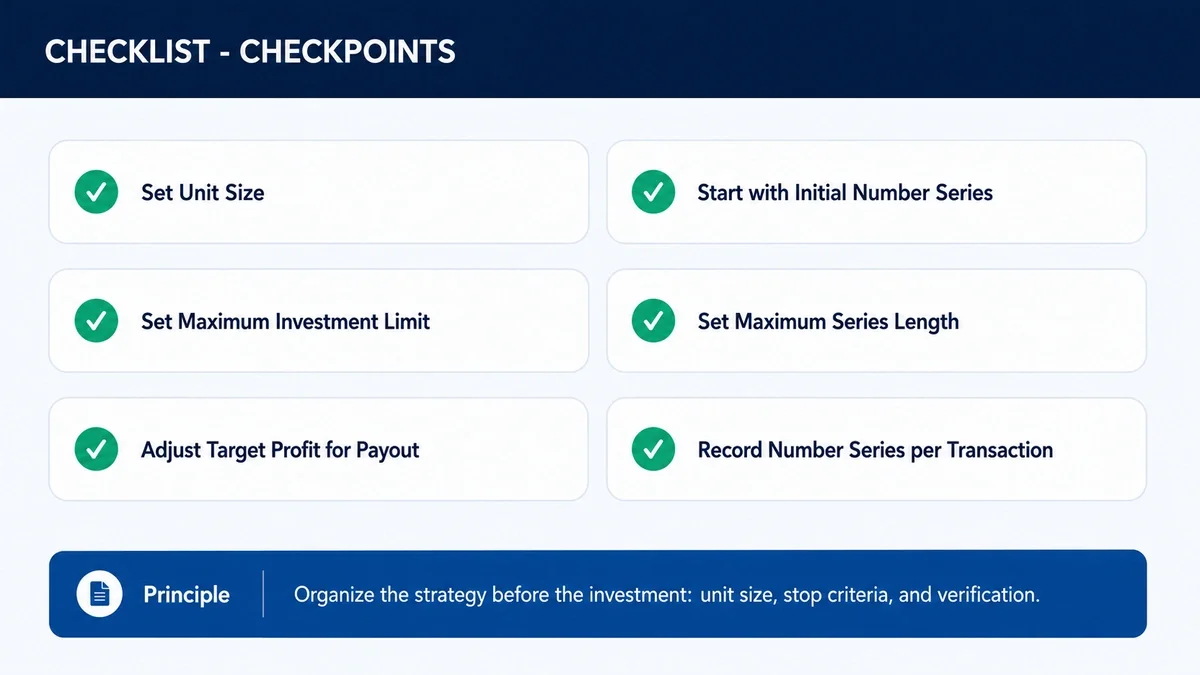
The first rule is to start with a short initial sequence.
The second rule is to keep the base amount small compared with the total account balance.
The third rule is to define a maximum sequence length. For example, a trader may decide to stop the series if the sequence becomes longer than seven numbers.
The fourth rule is to define a maximum single investment amount. If the next required trade exceeds that limit, the series should end.
The fifth rule is to include the payout rate in all calculations. A 95% payout rate and a 90% payout rate can create different final cumulative results even with the same number sequence.
The sixth rule is to record the sequence change for every trade. Labouchere cannot be properly evaluated without records.
Although the name may sound complicated, the strategy becomes much easier to understand when shown with number sequence examples and tables. The key is to help readers follow how:
[1, 2, 3, 4]
shrinks after wins and expands after losses.
For a first Labouchere test, a short sequence such as:
[1, 2, 3]
or:
[1, 2, 3, 4]
is usually more practical.
A short sequence makes the first investment amount and target profit easier to understand. It also helps prevent the series from becoming too long.
A longer sequence may look more strategic, but if losses occur, the sequence can become difficult to control. Each loss adds the investment amount to the end of the sequence, which can increase both the next trade size and the number of trades required to complete the series.
For blog content, it is better to focus on short sequence examples first. Longer sequences can be introduced as advanced variations that should only be tested in a demo account after the basic structure is fully understood.
Labouchere may be attractive to users who like numbers, records, and visible progress tracking.
The strategy allows traders to understand the current state of the series just by looking at the sequence. If the sequence is shrinking, the target is getting closer. If the sequence is expanding, the burden is increasing.
It can also appeal to users who want a more structured alternative to simple “double after loss” systems. Because the next investment amount comes from the sequence, the process can feel more rule-based and less emotional.
However, traders who do not keep records may lose one of the strategy’s biggest advantages. Labouchere is a record-based strategy, so without tracking the sequence properly, the structure becomes difficult to evaluate.
It is also not suitable for traders who continue the sequence no matter how long it becomes. The ability to stop is more important than the desire to complete the sequence.
When verifying the D’Alembert strategy, looking only at the win rate is not enough.
The most important indicators are the average stage and maximum stage.
If the average stage remains low, the strategy may be operating in a relatively stable way. If the maximum stage is frequently reached, it may suggest that the entry conditions or market environment need to be reviewed.
The same win rate can produce very different results depending on how wins and losses are distributed. If losses cluster together, the stage rises. If wins and losses are more balanced, the stage may remain lower.
During demo testing, traders should record:
Current stage
Trade result
Next stage
Cumulative profit/loss
Maximum stage reached
Number of trades required to return to stage 1
This helps show how gradual the D’Alembert strategy really feels compared with Martingale.
When testing the Labouchere strategy, traders should not look only at final profit or win rate.
The most important points are sequence length and completion rate.
If the sequence is completed often, it means the strategy frequently reaches its target. If the sequence keeps expanding, it means the burden is increasing.
Important data points include:
Initial sequence
Maximum sequence length reached
Maximum single investment amount
Number of trades required to complete the sequence
Number of incomplete or stopped sequences
Final cumulative profit/loss
This data helps traders create realistic stop rules.
It is also useful to compare different initial sequences. For example:
[1, 2, 3]
and:
[1, 2, 3, 4]
may produce different investment pressure and completion behavior.
By testing both under the same entry conditions, traders can better understand which sequence fits their account size and trading style.
The main appeal of Labouchere content is the visual movement of the number sequence.
Readers can follow how the sequence becomes shorter after wins and longer after losses. This makes the strategy more engaging than a simple explanation of investment increases.
The key points worth emphasizing are:
Target profit can be divided into a number sequence.
Wins and losses are reflected directly in the sequence.
The strategy is not a simple doubling system.
The current progress is visible.
Maximum sequence length and investment limits are essential.
The conclusion should emphasize that clearing the sequence is not more important than risk control.
A strong final message is:
In Labouchere, the real skill is not only completing the number sequence. It is knowing when the sequence has become too long and stopping before the investment burden becomes excessive.
To understand the Labouchere strategy properly, reading the explanation is not enough. Traders should test the same conditions repeatedly in a demo account.
Before testing, the following conditions should be fixed:
Base amount
Initial number sequence
Payout rate
Maximum sequence length
Maximum single investment amount
Stop rule
It is recommended to record at least 30 to 50 simulated trade flows.
During testing, recording only the final result is not enough. Each trade should include:
Starting sequence
Investment amount
Result
Net profit/loss
Cumulative profit/loss
Next sequence
Stop or continue decision
Since the number sequence is the core of the Labouchere strategy, the sequence change must be recorded carefully.
It is also useful to compare the same entry signals with fixed-amount trading. This helps determine whether the Labouchere structure improves the trading flow or simply increases complexity and investment pressure.
The first condition is the payout rate. If the payout rate is low, the final cumulative result can differ significantly from the theoretical sequence target.
The second condition is the trading environment. In highly volatile or directionless conditions, most money management strategies can perform poorly. Entry quality and market environment matter more than the sequence itself.
The third condition is trader personality. Labouchere can look attractive because the number sequence gives a clear target. However, if a trader feels pressured when the sequence becomes longer, the strategy may become difficult to follow.
The fourth condition is record discipline. Labouchere requires accurate sequence tracking. Without records, it becomes difficult to know whether the strategy is working properly.
For this reason, Labouchere should always be introduced with demo testing, small base amounts, short sequences, and clear stop limits.
The Labouchere strategy is not a formula that guarantees profit. It is a money management framework that organizes investment amounts through a number sequence.
Its advantage is that the target and progress are visible. However, the strategy only becomes meaningful when combined with proper market direction analysis, suitable trading timing, asset selection, payout conditions, and risk limits.
For blog content, the best approach is to explain the strategy through concrete numbers and sequence examples. Readers can understand the concept much more clearly when they see how:
[1, 2, 3, 4]
changes after wins and losses, and how the cumulative profit/loss develops from a base amount of 1,000.
The final recommendation is clear:
The Labouchere strategy should first be verified through demo testing, using a small base amount, a short initial sequence, a maximum sequence length, and a maximum single investment limit.
Presented this way, the article becomes more than a simple strategy introduction. It becomes a complete SEO-focused strategy guide that explains both the appeal and the limitations of number-sequence money management.
Q. What is the Labouchere strategy?
A. It is a money management strategy that calculates the investment amount by adding the first and last numbers of a sequence. After a win, those numbers are removed. After a loss, the investment amount is added to the end of the sequence.
Q. What changes when the payout rate is 95%?
A. Even if the sequence is fully cleared, the actual cumulative profit may not exactly match the total of the initial sequence because the payout rate is below 100%.
Q. How should the initial sequence be chosen?
A. Beginners should usually start with a short and simple sequence such as [1, 2, 3] or [1, 2, 3, 4].
Q. What is the most important risk limit?
A. The most important limits are the maximum sequence length and the maximum single investment amount.
Q. Is Labouchere easier than Martingale?
A. It is not necessarily easier. Martingale is simpler to calculate, while Labouchere requires accurate sequence tracking. However, Labouchere provides a clearer view of target progress through the number sequence.
Set your base amount and payout rate in a demo account, then directly compare the actual investment flow of the Binary Options 1-3-2-6 Strategy with the more conservative 1-3-2-4 variation.
Next Article:
Complete Guide to the Binary Options D’Alembert Strategy
Binary options and derivative trading involve the risk of losing principal and may not be suitable for all investors. The calculation examples in this article are assumptions designed to help explain the structure of the strategy. Actual results may vary depending on trading conditions, payout rates, execution environment, asset volatility, and the user’s entry criteria. This content is intended for general informational purposes only and does not guarantee specific profits or provide investment advice.