Binary Options Paroli Strategy - Complete Guide
A winning streak strategy that increases investment after each win and resets to the base amount after a loss.
1. What Is the Paroli Strategy?
2. A Structure That Does Not Chase Losses
3. Basic Cycle Design
4. Examples of 2-Win and 3-Win Streaks Based on a 95% Payout
5. What Happens If You Lose Midway?
6. Criteria for Choosing Half Paroli
7. Differences Between Martingale and Fibonacci Strategies
8. In What Situations Is It Attractive?
9. Practical Trading Tips
10. Real Trading Scenarios: 2-Win Exit vs. 3-Win Expansion
11. Market Conditions Best Suited for the Paroli Strategy
12. Recommended Operation Summary
13. Strategy Verification: Winning Streak Probability and Profit Drawback Range
14. Key Points to Emphasize in Content
15. Complete Paroli Strategy Demo Test Routine
16. Conditions to Check Before Applying the Complete Paroli Strategy
17. Final Recommended Position
18. Frequently Asked Questions
19. Risk Disclosure
The Paroli strategy is often described as a money management strategy that moves in the opposite direction of Martingale. While Martingale increases the investment after a loss, Paroli increases the investment after a win.
Rather than chasing losses to recover them, Paroli opens the next step based on an already winning flow.
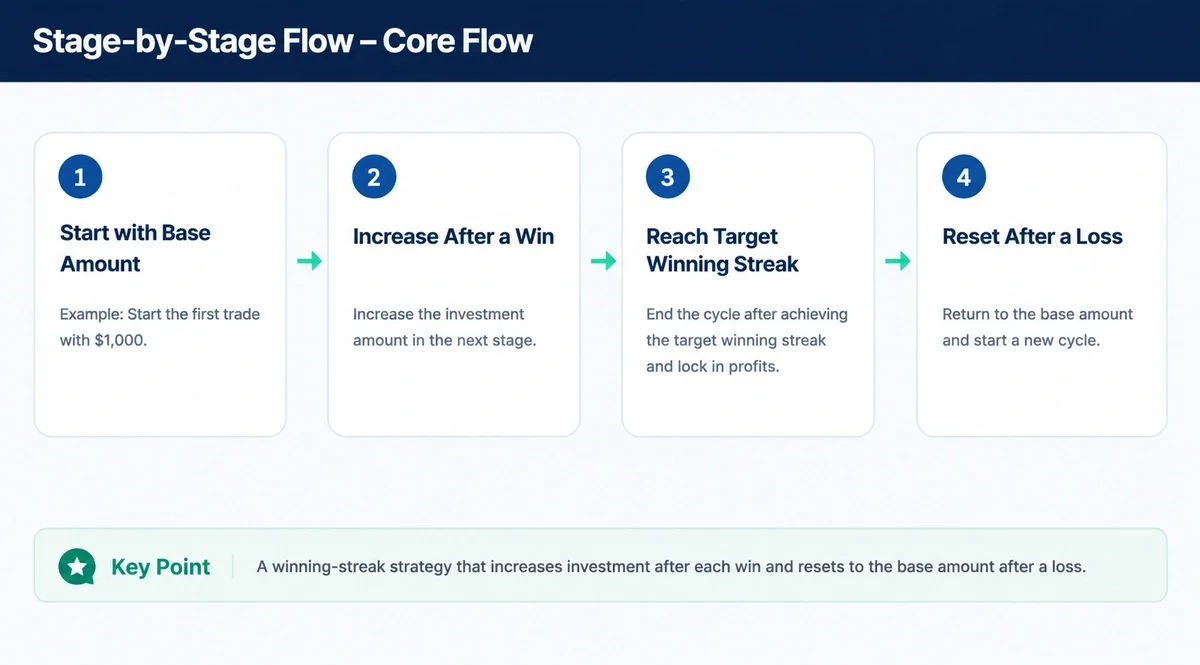
Because of this structure, Paroli is also called Reverse Martingale. You start with a base amount, increase the investment after a win, and lock in profits once you reach the target winning streak. If a loss occurs, you return to the base amount and start a new cycle.
The appeal of Paroli becomes clear during winning streaks. Even with the same 3-win streak, cumulative profit can differ significantly between fixed-amount trading and Paroli trading.
In this article, we’ll cover the core principles, 2-win and 3-win operations, Half Paroli, what happens after a loss midway, and how Paroli differs from other win-based investment increase strategies.
The Paroli strategy is a winning-streak approach that increases the investment after each win.
When a loss occurs, the cycle resets back to the base investment amount.
Defining the target number of consecutive wins in advance helps establish clear profit-taking rules.
Half Paroli is a more moderate variation compared to full doubling.
It is best understood as a strategy focused on expanding profit opportunities rather than recovering losses.
The Paroli strategy starts with a base investment amount on the first trade and increases the investment after each win. A common example follows a structure such as 1,000 → 2,000 → 4,000, doubling the amount after every successful trade. If the target is a 3-win streak, the cycle ends after winning the third trade.
When a loss occurs, the strategy resets to the original base amount regardless of the previous stage. This is the most important characteristic of the Paroli strategy. Instead of increasing the investment to recover losses, the strategy starts a new cycle with a smaller amount once the winning streak is broken.
Because of this, Paroli may appear aggressive, but psychologically it can feel more comfortable than Martingale. The reason is that it does not increase investment amounts after losses. However, since the investment size grows during winning streaks, failing to define a target number of consecutive wins can result in giving back a significant portion of profits at the final stage.
The core message of the Paroli strategy is: “Do not chase losses.”
When a loss occurs, the strategy returns to the base amount, and the next stage is opened only after a profitable trade. Because this structure focuses on maximizing profitable streaks rather than recovering losses, the overall feel of the strategy is psychologically more positive.
In binary options, where results are determined within a short period of time, the difference in capital allocation during winning streaks becomes highly noticeable. With fixed-amount trading, even a 3-win streak simply accumulates the same-sized profits, while Paroli can generate significantly larger gains during the second and third trades.
However, this structure is not always advantageous. If a loss occurs at the second stage after one win, part or even all of the initial profit may be given back. Therefore, the key to Paroli is not “always extending the winning streak,” but rather deciding in advance at which winning streak level the cycle should end.
A Paroli cycle consists of four elements: the base amount, target winning streak, increase multiplier, and reset rule.
The base amount should be set relatively small compared to the total account balance, while the target winning streak is usually kept short, such as 2 or 3 consecutive wins. Aiming for 4 or more wins increases the potential return, but also lowers the probability of success and raises the pressure at the final stage.
The increase multiplier is commonly introduced as a doubling system, but it does not necessarily have to be exactly 2x. A more moderate Half Paroli approach using multipliers such as 1.5x or 1.7x is also possible. The important part is consistently applying the rules:
“Move to the next stage after a win”
“Return to the base amount after a loss”
The cycle completion rule must also be clearly defined. If the target is a 2-win streak, the cycle ends after the second successful trade. If the target is a 3-win streak, it ends after the third successful trade.
Continuing beyond the predefined target changes the strategy from a profit-realization model into an overly aggressive winning-streak expectation strategy.
With a base amount of 1,000 and a 95% payout rate, a 2-win Paroli cycle works as follows:
First trade: 1,000 win → +950 profit
Second trade: 2,000 win → +1,900 profit
This results in a total cumulative profit of +2,850.
Under the same conditions, winning twice with a fixed investment of 1,000 would generate only +1,900, clearly showing the profit amplification effect of the Paroli strategy.
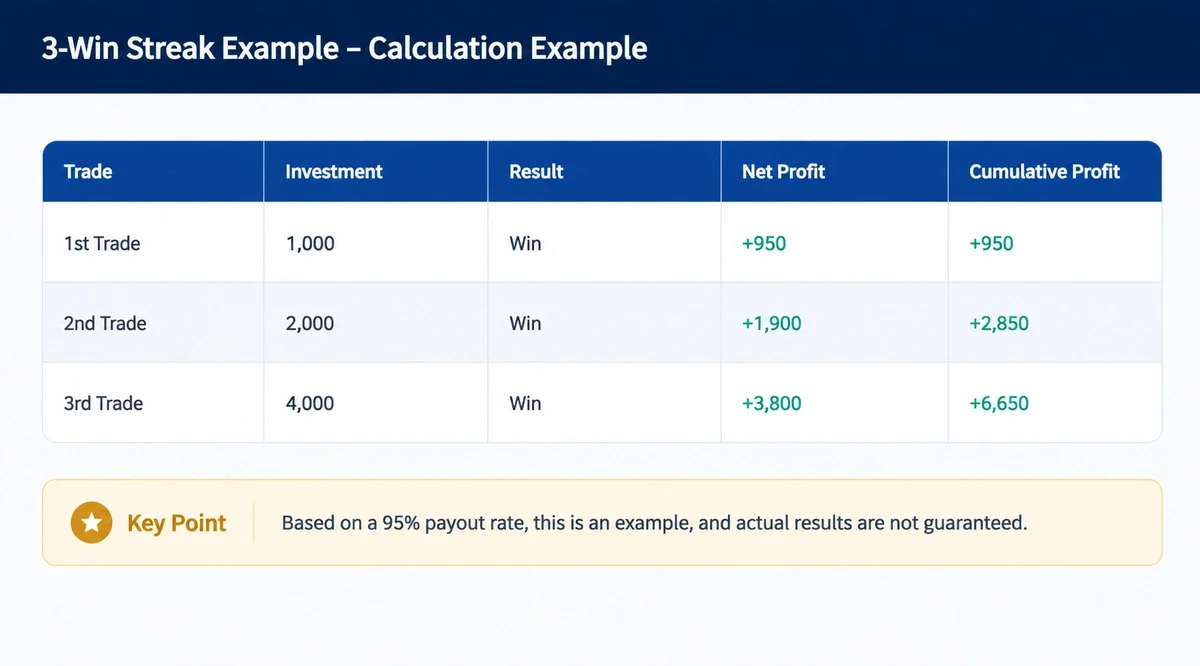
A 3-win Paroli cycle progresses as:
1,000 → 2,000 → 4,000
If all three trades win, the cumulative profit reaches +6,650.
By comparison, winning three fixed-amount trades of 1,000 each would produce only +2,850. This demonstrates how capital allocation methods can dramatically change profit potential even within the same win-rate environment.
However, targeting a 3-win streak is more difficult than targeting 2 consecutive wins. When testing the strategy for the first time, it is recommended to compare 2-win and 3-win completion models side by side.
A 2-win target allows for faster profit realization.
A 3-win target offers larger profit expansion, but the final-stage failure can result in a much larger profit giveback.
| Trade | Investment Amount | Result | Net Profit/Loss | Cumulative Profit/Loss |
|---|---|---|---|---|
| Round 1 | 1,000 | Win | +950 | +950 |
| Round 2 | 2,000 | Win | +1,900 | +2,850 |
| Round 3 | 4,000 | Win | +3,800 | +6,650 |
The most realistic consideration in the Paroli strategy is a mid-cycle loss.
If the first trade of 1,000 wins, the profit is +950. However, if the second trade of 2,000 loses, the cumulative result becomes -1,050. In other words, even with 1 win followed by 1 loss, the overall result can still end in a loss. This effect becomes even more noticeable because binary options payouts are not 100%.
On the other hand, if the first trade loses, the loss simply ends at -1,000, and the cycle restarts from the base amount. This is a major difference from Martingale. Since Paroli does not increase the investment after losses, capital does not explode during losing streaks.
As a result, Paroli performs strongly during winning streaks, but it becomes difficult to generate profits in conditions where wins are immediately followed by losses repeatedly.
This strategy is therefore more naturally suited to:
short-term trending market conditions,
situations with clear entry signals,
and environments where consecutive wins are realistically possible.
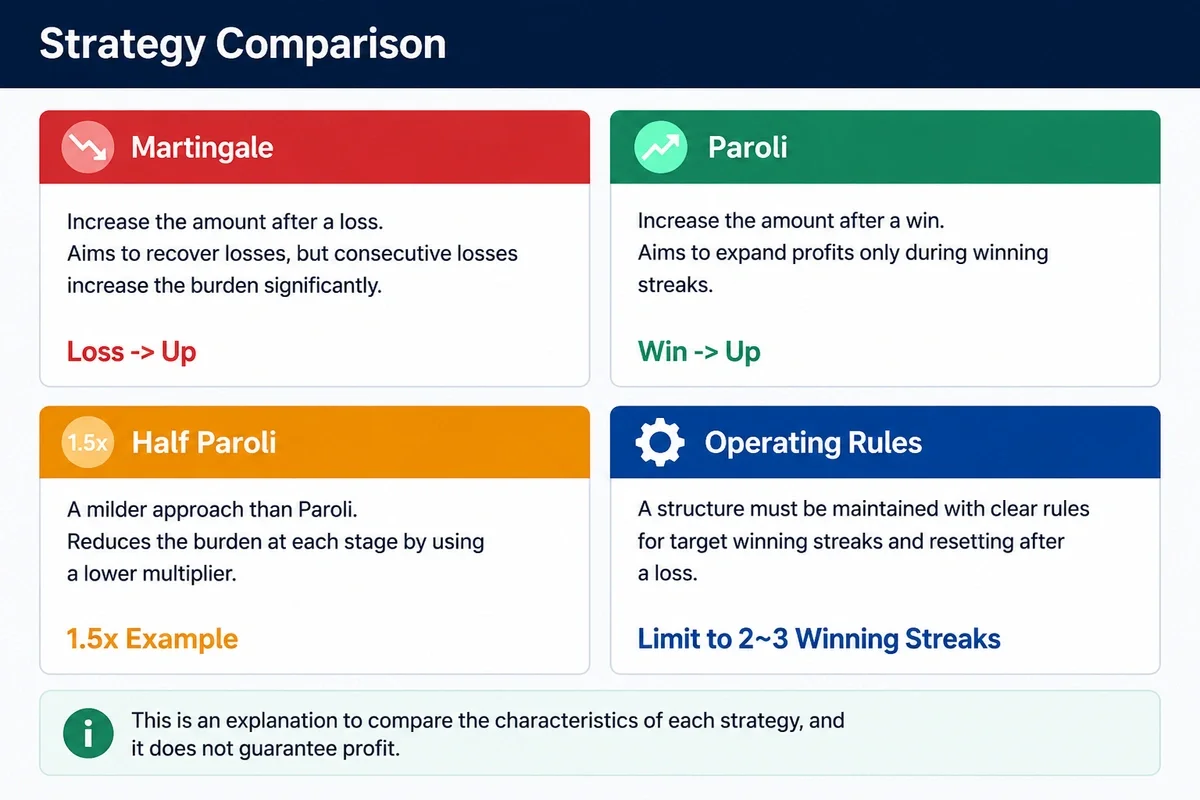
Half Paroli is a variation that increases the investment more gradually after a win instead of doubling it.
For example:
1,000 → 1,500 → 2,250
This approach still aims to expand profits during winning streaks while reducing the stage-by-stage pressure compared to standard Paroli.
Half Paroli is especially suitable in three situations:
When the 2nd and 3rd stage amounts of standard Paroli feel psychologically or financially burdensome.
When using a strategy that frequently produces short winning streaks but rarely extends for long sequences.
When reducing profit giveback is considered more important than maximizing profit expansion.
Although Half Paroli grows profits more slowly, it often provides a greater sense of operational stability.
For this reason, Paroli strategy guides are more effective when they introduce both the standard and Half Paroli models together, allowing readers to choose the approach that best matches their personal trading style and risk tolerance.
Martingale increases the investment amount after a loss, while Paroli increases the investment after a win. Although this difference seems simple, it completely changes the psychological nature of the strategy. Martingale is a loss-recovery model, whereas Paroli is a winning-streak utilization model.
The Fibonacci progression strategy is somewhat similar to Paroli in that it also increases investment after wins. However, Fibonacci uses a more gradual sequence such as 1, 1, 2, 3, 5, resulting in a slower growth rate than Paroli.
Paroli focuses on rapid profit expansion.
Fibonacci focuses more on gradual profit protection.
This comparison makes the position of Paroli much clearer. For users who feel uncomfortable with loss-chasing strategies and want to actively capitalize on winning streaks, Paroli is often the most intuitive choice.
On the other hand, users who want to reduce profit giveback after a winning streak followed by a loss may feel more comfortable with the Fibonacci approach.
Paroli can feel particularly attractive in market conditions where price moves consistently in one direction for short periods, or when a trader’s entry criteria repeatedly perform well within a certain timeframe.
For example, if trading signals tend to work consistently during a specific session or time window on the same asset, the profit amplification effect of Paroli may become much more noticeable compared to fixed-amount trading.
Paroli is also easier to explain to users who want to reduce the psychological pressure of recovering losses. Since the strategy resets to the base amount after a loss, it avoids aggressively chasing the market after losing trades. This can feel like an important advantage, especially for beginners.
However, traders should never become overconfident in winning streaks. It is important to define a target such as 2 or 3 consecutive wins and develop the discipline to stop once that target is reached.
Paroli is a strategy that becomes aggressive only while winning, but if the expectation of “continuing to win” grows too strong, profits can easily be given back at the final stage.
At the beginning, it is recommended to conduct demo testing with a 2-win streak target. Once the 2-win structure becomes familiar, compare it with a 3-win target model. During this process, do not focus only on total profits. You should also record how often losses occurred after a single win and how psychologically burdensome third-stage failures felt after reaching two consecutive wins.
The second tip is to stop immediately once the target is reached. The strength of Paroli lies in expanding profits and then locking them in. If you continue to the next stage even after achieving the target, the series risk increases significantly. The clearer the profit-taking rules are, the more effectively the strategy works.
The third tip is to compare and test Half Paroli alongside the standard version. Standard Paroli can generate larger profits, while Half Paroli may reduce the size of profit givebacks. Depending on the trader’s personality and account size, the more suitable approach may differ.
The nature of Paroli changes depending on the target number of consecutive wins. The 2-win exit model focuses on securing profits quickly, while the 3-win expansion model aims for larger profit growth. Even with the same base amount, changing the target winning streak completely changes the perceived risk of the strategy.
The 2-win exit model stops after the second trade following the first successful trade. If successful, the cycle ends relatively quickly, and even if it fails, the loss size remains limited.
In contrast, the 3-win expansion model offers a much larger profit opportunity at the third trade, but it also introduces the possibility of giving back profits accumulated during the first and second stages.
For beginners, it is generally better to start with the 2-win exit model first. Later, by comparing it with the 3-win expansion model through demo testing, traders can determine whether their personality is better suited to fast profit realization or larger profit expansion.
Paroli works best in market conditions where directional momentum continues for short periods. For example, after major news events, volatility may continue in one direction, or a specific trading signal may repeatedly succeed during a particular session. In these situations, the advantage of increasing investment after wins becomes more visible.
On the other hand, Paroli tends to lose efficiency in sideways markets where price direction frequently changes. If the pattern repeatedly becomes “1 win followed by 1 loss,” the second-stage loss may feel larger than the initial profit gained.
Therefore, Paroli should not be positioned as a strategy to use all the time, but rather as a strategy to use briefly only when there is a reasonable expectation of consecutive wins. This positioning feels much more realistic and convincing to readers.
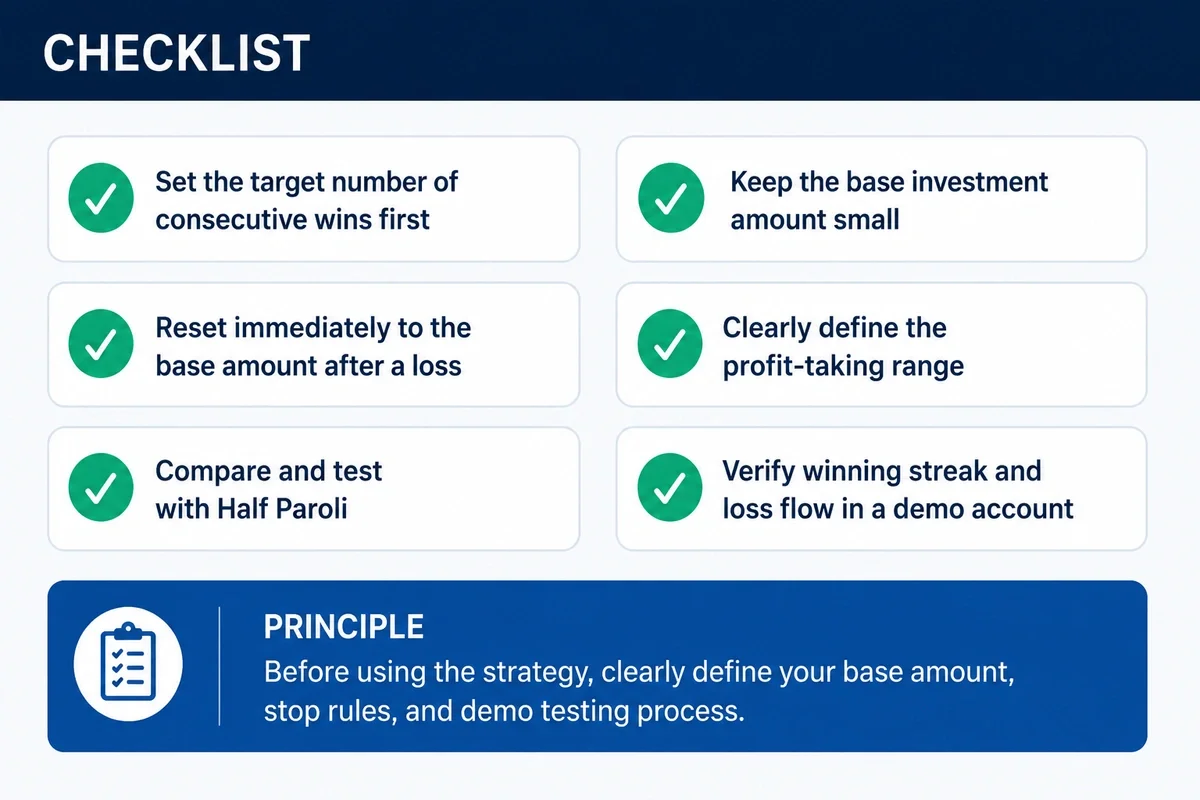
The core principle of operating Paroli is deciding the target number of consecutive wins in advance.
If the target is 2 wins, stop after 2 consecutive wins.
If the target is 3 wins, stop after 3 consecutive wins.
Continuing beyond the target changes Paroli from a profit-realization strategy into an unlimited winning-streak expectation strategy.
The second rule is immediate reset after a loss. Returning to the base amount after losing is the essence of Paroli. If you maintain the stage after a loss or increase the amount to recover losses, the strategy effectively turns into a completely different hybrid closer to Martingale.
A practical recommendation is:
Base amount: 1,000
Target: 2 consecutive wins
Compare with Half Paroli through demo testing
This combination allows traders to directly experience the difference between aggression and stability, while also providing blog readers with a realistic and actionable guide.
In Paroli testing, the probability of consecutive wins is more important than the overall win rate. You must analyze:
how often a second win follows the first win,
and how frequently a third-stage success occurs after two consecutive wins.
It is also important to record the size of profit givebacks. Observe:
how much loss occurs when the second stage fails after one win,
and how cumulative profit changes when the third stage fails after two consecutive wins.
This reveals the true psychological experience of using Paroli.
Demo records should separate:
2-win target models
and 3-win target models.
Even with identical entry conditions, total profits and drawdown sizes can vary significantly depending on the target winning streak.
The core message of Paroli content is:
“Be aggressive only when winning.”
The fact that it does not chase losses is the biggest difference from Martingale and creates a psychologically positive impression for readers.
The main points worth emphasizing are:
utilizing winning streaks,
creating clear profit-taking rules through target winning streaks,
and reducing pressure through Half Paroli.
Repeating these ideas throughout the article helps clarify the strategy’s identity.
Paroli is especially effective when presented after a Martingale article because the contrast becomes very clear. While Martingale focuses on increasing investment after losses, Paroli explains the exact opposite structure: increasing investment after wins.
To truly understand the Complete Paroli Strategy, reading alone is not enough. You should repeatedly test the same conditions in a demo account.
Fix:
the base amount,
payout rate,
target stages,
and stop rules,
then record at least 30–50 simulated trades. Doing this makes both the advantages and psychological burdens of the strategy much clearer.
During testing, recording only final profits is insufficient. You should also document:
investment amount for each trade,
trade result,
net profit/loss,
cumulative profit/loss,
and the next stage or decision criteria.
This helps reveal not only whether the strategy made money, but also where psychological pressure increased.
Since capital allocation is the essence of the Complete Paroli Strategy, it is highly recommended to compare the same entry signals with fixed-amount trading. This makes it easier to evaluate:
whether profit expansion actually occurred,
and how much additional pressure appeared during losing periods.
The first condition is the payout rate. If the payout is low, the final cumulative profit can differ greatly even with the same win rate and investment flow. Therefore, payout conditions should always be checked before explaining or applying the strategy.
The second condition is the trading environment. In markets with excessive volatility or constantly changing direction, most money management strategies can perform poorly. Readers should clearly understand that entry conditions and market environment matter more than the strategy itself.
The third condition is the trader’s personality. Even if the Complete Paroli Strategy looks attractive numerically, it may not suit someone who struggles psychologically when investment amounts become larger during winning streaks.
For this reason, the article should explain not only the strengths of the strategy, but also what type of trader personality it best fits.
The Complete Paroli Strategy is not a formula that guarantees profits on its own. It is a money management strategy that organizes how investment amounts are allocated.
For the strategy to work effectively, the following factors must align together:
directional prediction,
trading session timing,
asset selection,
and payout conditions.
In blog content, the best approach is not exaggeration, but presenting the strategy through concrete numbers and realistic scenarios. Readers understand much more clearly when they see how actual investment amounts and cumulative profits change starting from a base amount such as 1,000.
Therefore, the final recommendation is clear:
The Complete Paroli Strategy becomes meaningful only when:
the structure is first verified through demo testing,
the base amount is kept small,
and the strategy is used strictly within predefined stop rules.
Organized this way, the article becomes more than a simple strategy introduction—it turns into a complete SEO-focused strategy guide.
Q. What is the Paroli strategy?
A. It is a money management method that increases the investment amount after a win and resets to the base amount after a loss.
Q. What is an appropriate winning streak target?
A. Beginners should compare 2-win and 3-win target models through testing, and it is recommended to stop once the target is reached.
Q. When should Half Paroli be used?
A. It can be considered as a more moderate alternative when the growth speed of standard Paroli feels too aggressive or psychologically burdensome.
Q. Is Paroli safer than Martingale?
A. It differs in that it does not increase investment after losses, but losses occurring after winning streak stages can still result in profit givebacks.
Increase Your Investment Only During Winning Streaks
Set your base amount and payout rate in a demo account, and directly compare the real investment flow of the Complete Binary Options Paroli Strategy.
Next Article:
Complete Guide to the Binary Options Fibonacci Progression Strategy
Binary options and derivative trading involve the risk of losing principal and may not be suitable for all investors. The calculation examples in this article are assumptions designed to help explain the structure of the strategy. Actual results may vary depending on trading conditions, payout rates, execution environment, asset volatility, and the user’s entry criteria. This content is intended for general informational purposes only and does not guarantee specific profits or provide investment advice.