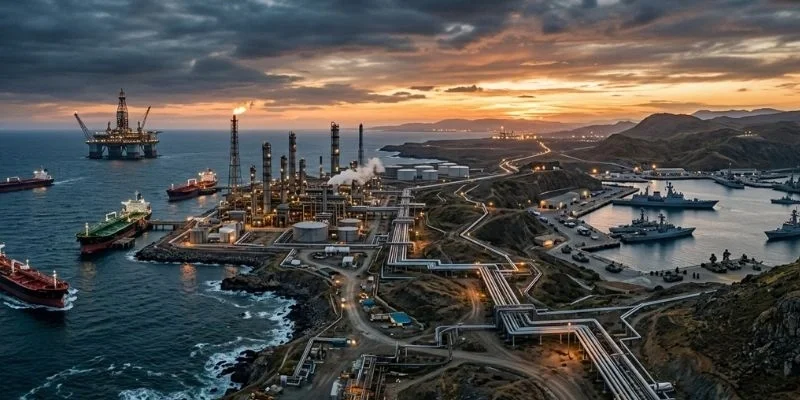
The weekend of March 8, 2026, began with the deceptive quiet of a typical market lull, but by Sunday evening, that peace had been decimated. An abrupt and violent escalation in the Middle East—drawing the United States, Israel, and Iran into a direct confrontation—evaporated the weekend’s liquidity in a matter of hours. As the conflict intensified, oil prices tore through the $100-per-barrel ceiling, sending Wall Street futures into a tailspin. For global macro players, this is no longer a "tail risk" to be debated; it is an active energy shock that is fundamentally re-pricing global assets in real time.
While global eyes are fixed on West Texas Intermediate (WTI) and Brent, the real story lies in the regional benchmarks that have already shattered the triple-digit barrier.
- The Regional Vanguard: As of Sunday night, Abu Dhabi’s Murban crude reached $103 per barrel, while Oman crude surged to $107
- A Historic Anomaly: WTI futures recorded a staggering 35% weekly surge—the largest one-week jump since 1983.
- The Hormuz Bottleneck: The primary driver is the effective closure of the world’s most vital energy artery.
"Transit through the Strait of Hormuz has been severely restricted. Current intelligence confirms that only Iran-linked tankers and select neutral bulk carriers have cleared the passage,
effectively partitioning the global energy supply chain."
The volatility is anchored by a tectonic shift in Iranian leadership. Following the death of Ali Khamenei, his son, Mojtaba Khamenei, has been officially named the new Supreme Leader. His appointment signals a definitive end to any hopes of a diplomatic pivot, suggesting instead that Tehran will lean into its confrontational stance with the West. Investors are now pricing in a leadership era defined by permanent friction.
In a move that has stunned political analysts, Donald Trump has reframed the economic fallout. Historically, high energy prices are political poison, yet Trump has adopted a "Small Price" doctrine regarding the neutralization of Iran.
- Strategic Priority Over Economic Stability: Trump argued that the spike in energy costs is a secondary concern compared to the strategic objective of dismantling Iran’s nuclear capabilities.
- The Stance: "Short-term oil price increases are a 'very small price to pay' to destroy the nuclear threat."
The energy shock has triggered an immediate and deep sell-off across U.S. and Asian markets. For Japan, a nation with minimal energy self-sufficiency, the crisis presents a "Double Punch": the combination of a persistently weak Yen and skyrocketing import costs.
As markets opened, Japan’s heavyweight semiconductor and automotive sectors saw historic sell-offs, reflecting fears of a complete stall in the global manufacturing engine:
- Tokyo Electron: Down 9.2% (Fears of shrinking semiconductor equipment demand)
- Advantest: Down 10.1% (Anticipated drop in global chip fabrication rates)
- Toyota Motor: Down 8.8% (Rising logistics costs and weakening household consumption)
In response, the Japanese government and the Bank of Japan (BoJ) have convened emergency meetings to discuss a ¥20 trillion energy subsidy package and potential direct foreign exchange intervention to stabilize the Yen against imported inflation.
The Federal Reserve’s Stagflationary Nightmare
As of Sunday night, the bleeding on global futures was clear:
- Nasdaq 100 Futures: Down 1.8% (24,234.0 points)
- S&P 500 Futures: Down 1.7% (6,632.75 points)
- Nikkei 225 Futures: Down 2.5% (Showing the highest sensitivity among Asian markets)
The Federal Reserve now faces the ultimate policy dilemma: Stagflation. Rising oil fuels inflation, mandating high interest rates, while the collapse of Japan’s industrial giants suggests a global recession is imminent.
The events of March 8, 2026, have institutionalized a new era of volatility. For energy importers like Japan, $100+ oil is not just a market fluctuation—it is an existential threat to the national economic model. The question for investors is no longer about the timing of the next rate cut, but about survival in a high-cost, high-friction world.